
From the Pages: The “Quiet Storm” (Impact over Visibility)
(EI & Relationship Mastery Newsletter – Season 4, Article 6)
Good afternoon.
Welcome back to Season 4 of “EI & Relationship Mastery.”
We live in a world that is obsessed with the visible.
We reward the person who stands at the front of the room.
We promote the person who sends the most emails.
We celebrate the person who makes the most noise.
In corporate cultures, we often confuse Visibility with Value. We assume that if we can’t see you, you aren’t doing anything.
But there is a different kind of force in nature. It is not the flash of lightning that strikes instantly and vanishes. It is the deep, hydraulic pressure of a rising tide. It is the slow, gathering intensity of a storm system that builds quietly over the ocean until it has enough energy to reshape the entire coastline.
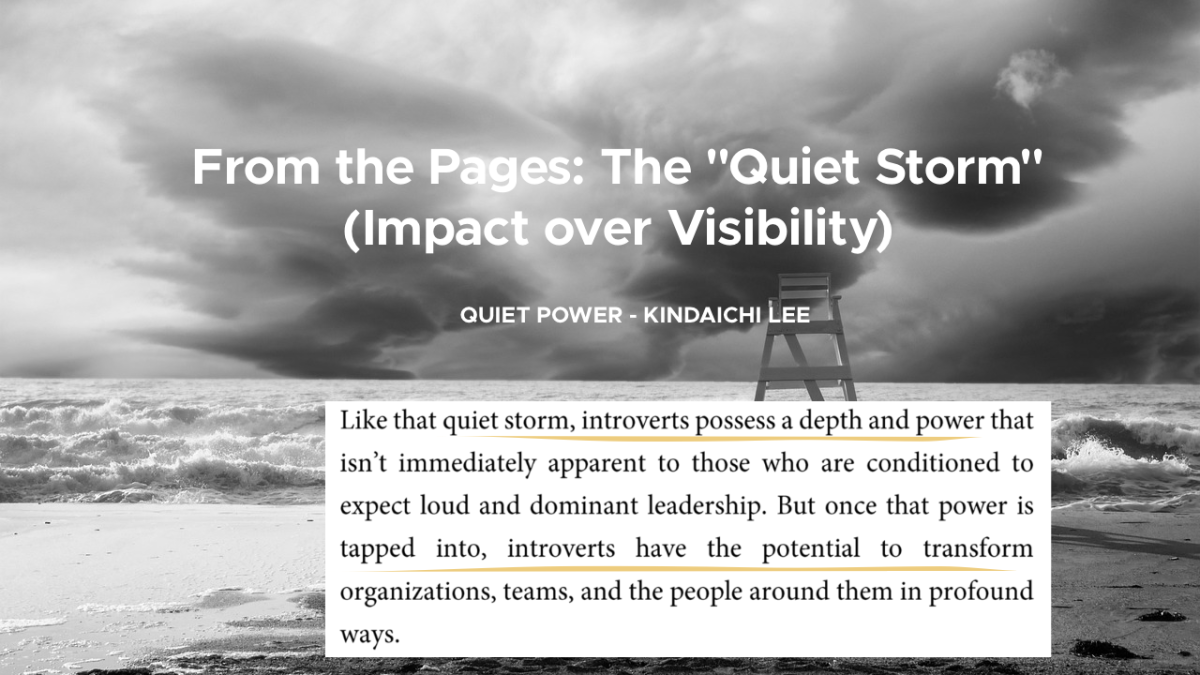
In Chapter 2 of my book, “Quiet Power: Leading with Impact,” I use this metaphor to describe the hidden potential of the introverted leader. I wrote:
“Like that quiet storm, introverts possess a depth and power that isn’t immediately apparent… But once that power is tapped into, introverts have the potential to transform organizations, teams, and the people around them in profound ways.”
Today, we are going to explore the concept of The Quiet Storm.
We are going to look at the difference between “Performing Work” (looking busy) and “Deep Impact” (creating value). And I am going to share the “Zero to Hero” story of a client who was treated like office furniture until his quiet, invisible work saved the entire company from ruin.
The Visibility Trap: The Peacock vs. The Architect
In my coaching practice, I often draw a distinction between two types of employees.
1. The Peacock (High Visibility, Variable Impact)
This person is everywhere. They speak in every meeting. They CC every executive on their emails. They are masters of “optical busyness.” They are often rewarded early because they are easy to see.
2. The Quiet Storm (Low Visibility, High Impact)
This person is often invisible. They are the Deep Divers and the System Architects. They don’t spend time talking about the work because they are too busy doing the work. They are building the infrastructure, fixing the code, and analyzing the risks.
The problem is that many organizations only promote the Peacock. They ignore the Quiet Storm until it is too late.
But when a Quiet Storm leader finally unleashes their accumulated value, it is not a ripple; it is a transformation.
The Case Study: The “Invisible” Finance Guy
Let me introduce you to “Ken” (name changed).
Ken was a financial analyst at a high-growth retail startup. The culture was chaotic, loud, and dominated by the Sales team. The Sales Directors were the “Action Heroes”—they rang bells when they closed deals, they popped champagne, and they were the CEO’s favorites.
Ken worked in the back. He was introverted, soft-spoken, and meticulous. In meetings, the Sales Directors would interrupt him or roll their eyes when he brought up “boring” things like margin erosion or supply chain costs.
“I feel like I’m screaming underwater,” Ken told me. “They are celebrating revenue, but they don’t see that for every dollar we bring in, we are bleeding $1.10 in operational inefficiencies. But nobody listens to the boring finance guy.”
Ken was ignored. He was overlooked for a promotion to Finance Manager in favor of a more “charismatic” external hire.
Ken didn’t quit. Instead, he became a Quiet Storm.
The Gathering Pressure
Ken stopped trying to win arguments in meetings. He went to his Still-Point. He decided to stop talking about the problem and start building a model that would make the problem undeniable.
For three months, while the Sales team partied and the “Peacocks” preened, Ken did the deep, invisible work.
- He dug into the API of their shipping provider.
- He analyzed 12,000 individual transactions.
- He built a predictive model that linked sales discounts to long-term customer value.
He worked in the dark. Nobody saw him. He was building the storm.
The Unleashing
The tipping point came at the Q3 Board Meeting. The Sales Director presented a flashy deck showing record revenue. “We are crushing it!” he announced. The Board was clapping.
Then, the CEO turned to the CFO (who had invited Ken). “Do we have the profitability forecast?”
Ken stood up. He didn’t have a flashy speech. He connected his laptop and opened a single dashboard he had built.
“This is the revenue,” Ken said quietly, pointing to the line going up.
“And this,” he pointed to a red line plummeting down, “is our actual cash position based on the current discount structure and shipping returns.”
The room went silent.
Ken continued, his voice steady with the weight of conviction. “Based on the model I have built, if we continue ‘crushing it’ at this rate, we will be insolvent in 14 weeks. We are paying customers to take our product.”
He then clicked a button. “However, if we adjust the discount cap by 4% and shift shipping providers for orders under $50—a plan I have already outlined here—we become profitable in 30 days.”
It wasn’t a presentation. It was a revelation.
The “boring” work Ken had done in the dark was suddenly the most important thing in the company. The “Peacocks” had no defense against his data.
The Transformation
The impact was immediate and profound.
- Strategic Shift: The Board immediately adopted Ken’s plan. The company pivoted from “Growth at all costs” to “Unit Economics.”
- Cultural Shift: The CEO realized he had been listening to the wrong people. He started inviting Ken to strategy meetings, not for his charisma, but for his Clarity.
- Personal Shift: Ken was promoted to Director of Strategy within six months.
Ken saved the company. He didn’t do it by being louder. He did it by being deeper. He proved that Impact is not about how many people look at you; it’s about how much the foundation shifts because of you.
How to Become a Quiet Storm
If you are working in the background—in Ops, Tech, Finance, or HR—and feeling invisible, do not lose heart. Do not try to become a Peacock. Double down on being a Storm.
1. Focus on the “Vital Non-Visible”
Ask yourself: What is the one thing in this company that, if it breaks, destroys everything?
It might be the server architecture. It might be the cash flow model. It might be the employee retention rate.
Make that your domain. Master it. The person who holds the keys to the engine room is always more powerful than the person painting the hull.
2. Document Your Depth
Ken didn’t just have a feeling; he had a model. Quiet Power requires evidence. Don’t just complain about a problem; build the simulation that proves it. Use the Artifact Strategy (from Article 1) to make your invisible work visible in a way that demands respect.
3. Wait for the “Leverage Point”
Ken didn’t interrupt the sales meeting every week. He waited for the Board Meeting where his data would have maximum impact. The Quiet Storm knows when to strike. Use Strategic Silence until you have the “Kill Shot” of data.
4. Build Alliances, Not Audiences
Peacocks want an audience. Storms need alliances. Ken worked with the CFO. Find the one or two people who actually care about the truth, and show them your work. You don’t need everyone to like you; you need the right people to respect you.
The Paradox of Recognition
Here is the beautiful irony of Ken’s story, and of the Quiet Storm concept.
When Ken was trying to be “noticed” in meetings, he was ignored.
When he stopped caring about being noticed and focused entirely on being impactful, he became the most noticed person in the company.
As I wrote in the book:
“You do not need to scream to be heard. You simply need to be true.”
If you are an introvert, your power lies in your depth. It lies in your ability to sit with a problem longer than anyone else. It lies in your ability to build the systems that others take for granted.
Trust that power. Let the pressure build. And when the time is right, unleash it.
Until next week, keep building in the dark.
Kindaichi Lee, Your Transformative Storyteller 🎬