
From the Pages: The Long-Game Vision (Tortoise vs. Hare)
(EI & Relationship Mastery Newsletter – Season 4, Article 10 – SERIES FINALE)
Good morning from a sunny Kuala Lumpur.
Welcome to the finale of Season 4 of “EI & Relationship Mastery.”
Over the past ten weeks, we have taken the core concepts from my new book, “Quiet Power: Leading with Impact,”and brought them to life. We have explored the mechanics of quiet authority, the ROI of empathy, the exhaustion of the extrovert mask, and the vital necessity of pruning your energy.
Today, we close this series with a look at the horizon. We are going to examine the ultimate battleground of modern leadership: Time.
Specifically, we are going to talk about the speed at which we are expected to operate, and the tremendous courage it takes to deliberately slow down.
For the last two decades, the corporate world has been infected by a singular mantra, born in Silicon Valley but exported globally: “Move fast and break things.”
We idolize the sprint. We celebrate the overnight disruption. We reward leaders who make lightning-fast decisions, even if those decisions are reckless. We have created a culture where speed is often mistaken for strategy, and activity is mistaken for progress.
But what happens when you are leading a team, and the thing that gets broken is your company’s reputation, your team’s mental health, or your bottom line?
In Chapter 3 of Quiet Power, I address this head-on. On it’s page, I wrote:
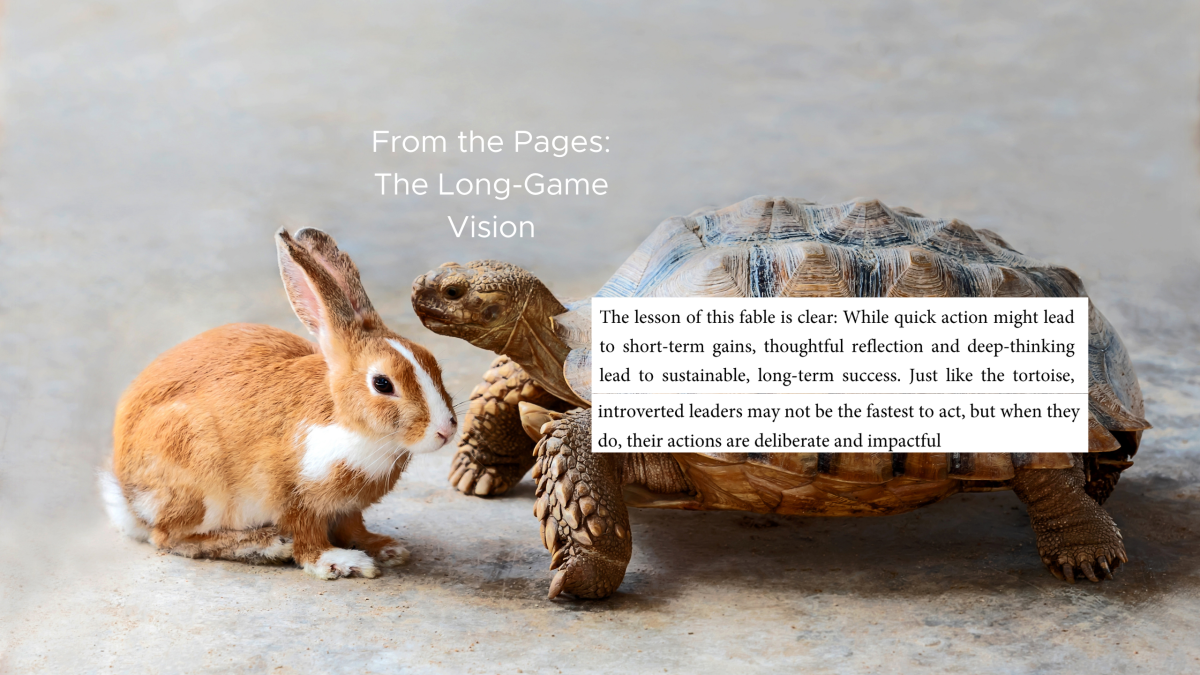
“While quick action might lead to short-term gains, thoughtful reflection and deep-thinking lead to sustainable, long-term success. Just like the tortoise, introverted leaders may not be the fastest to act, but when they do, their actions are deliberate and impactful.”
Today, we are going to explore the Long-Game Vision.
I am going to share the story of a client who stood her ground against a panicked executive team, refused to make a hasty decision, and in doing so, saved her company from a catastrophic, multi-million dollar mistake.
The Cult of Velocity and the Illusion of Progress
Let’s be clear: in certain situations—like a literal fire or a sudden PR crisis—speed is necessary. But in the realm of complex strategy, product development, and culture building, speed is often a trauma response.
When a leader says, “We need to do this now,” it is usually driven by fear. Fear of a competitor. Fear of missing a trend. Fear of looking inactive.
The “Action Hero” leader feeds on this adrenaline. They act quickly to relieve the anxiety of the unknown. They get a quick dopamine hit from the illusion of progress.
But the introverted leader—the Map Maker—understands that rushing through a minefield is a terrible strategy.
When you move too fast:
- You solve symptoms, not root causes.
- You alienate your team by forcing them into constant fire-drills.
- You miss the critical, nuanced data points that only reveal themselves through reflection.
The Tortoise doesn’t win the race because the Hare takes a nap. The Tortoise wins because the Tortoise never veers off the path. Their power is not in their velocity; it is in their Trajectory.
The Case Study: The 30-Day Sprint to Disaster
Let me introduce you to “Maya” (name changed).
Maya was the Head of Product at a rapidly growing FinTech (Financial Technology) startup. She was deeply analytical, a classic Deep Diver, and highly respected by her engineering team for her meticulous planning.
One Tuesday, a massive competitor launched a flashy new feature: an AI-driven automated trading bot. The market went wild. The press praised the competitor for being “innovative” and “agile.”
Maya’s CEO, a highly extroverted and reactive leader, panicked. He called an emergency executive meeting.
“We are getting left behind!” the CEO announced, pacing the boardroom. “I want our version of that AI trading bot live in 30 days. Cancel the current roadmap. Move everyone onto this. We have to strike now while the iron is hot.”
The room was buzzing with anxious energy. The “Action Heroes” in the room nodded along. Yes, let’s sprint. Let’s disrupt.
Then, Maya spoke up. She used her Quiet Authority.
“No,” she said calmly. “We cannot launch an automated financial product in 30 days. Our standard security and compliance cycle is 90 days. If we rush this, we are exposing our users to unacceptable risk.”
The CEO was furious. “Maya, this is the ‘Move Fast and Break Things’ era! If we wait 90 days, the market is gone. We’ll fix the bugs after we launch.”
Maya didn’t raise her voice, but she held her ground. “We are dealing with people’s life savings, not a photo-sharing app. If we break things, we break our customers’ trust. And in finance, trust is the only product we actually sell. Give me 72 hours to do a deep-dive feasibility and risk assessment. If I can find a safe way to do it in 30 days, we will. But I will not blindly commit our engineering team to a sprint today.”
The Power of the Pause
Maya utilized the Power of the Pause. While the rest of the executive team spent the next three days running around in a state of hyper-activity, Maya went into her Still-Point.
She shut her door. She didn’t look at the competitor’s press releases. She looked at the data. She looked at the regulatory frameworks. She looked at the underlying algorithms required for the AI.
On Friday, she returned to the CEO’s office. She handed him a 5-page brief.
“I have done the deep-thinking,” Maya said. “To build this in 30 days, we would have to bypass three critical layers of data encryption and skip our stress-testing phase with the regulatory body. But more importantly, I’ve analyzed the competitor’s release notes. Their algorithm has a structural flaw. In a highly volatile market event, it will trigger a cascade of unauthorised sell-offs.”
She paused, letting the silence do the heavy lifting (Strategic Silence).
“If we launch now,” she concluded, “we aren’t catching up to them. We are following them off a cliff.”
The CEO, faced with undeniable, meticulously researched clarity, backed down. “Okay,” he sighed. “We stick to the 90-day plan. Build it right.”
The Vindication of the Tortoise
The next few weeks were uncomfortable. The competitor was getting all the headlines. Maya’s team was working quietly, deliberately, and slowly in the background.
Then, exactly 40 days after the competitor’s launch, the market took a sudden, unexpected dip.
Maya’s prediction came true. The competitor’s “agile, fast-tracked” AI bot panicked. It triggered a cascade of unauthorised sell-offs, costing their users millions of dollars in a matter of hours. The regulatory bodies swooped in, freezing their assets and launching a massive investigation. The competitor’s stock plummeted 60% in two days. Their reputation was destroyed overnight.
Fifty days later, Maya’s company launched their AI feature. It was secure. It was fully compliant. It had been stress-tested.
Because the competitor had imploded, Maya’s company didn’t just capture a share of the market; they captured all of it. The customers who had fled the competitor migrated to Maya’s platform, desperate for security and reliability.
Maya didn’t win because she was the fastest. She won because she played the Long-Game. Her thoughtful reflection and deep-thinking saved the company from a fatal error and positioned them for sustainable dominance.
How to Cultivate the Long-Game Vision
If you are an introverted leader constantly feeling pressured to make snap decisions, you must build defense mechanisms against the cult of velocity. Here is how:
1. The 48-Hour Strategic Rule
Make it a personal policy: You do not make high-stakes strategic decisions in the room where they are proposed.
- The Script: “This is a massive pivot. I agree it requires our attention. I am going to take 48 hours to run the risk models and reflect on the second-order consequences. I will have a definitive recommendation by Thursday at noon.”
2. Differentiate Urgency from Importance
The Hare reacts to everything that is loud. The Tortoise focuses on what is important. When a “fire drill” happens, ask yourself: Will this matter in 6 months? If the answer is no, do not derail your team’s deep work to fix it. Delegate it, or let it burn. Protect the Long-Game.
3. Reward the “Unseen” Saves
In corporate culture, we give awards to the person who puts out the massive fire. We rarely reward the person who quietly fireproofed the building so the fire never started. As a leader, start publicly celebrating the “Maya”s on your team—the people whose deliberate, careful planning prevented a crisis.
The End of an Era, The Beginning of a Legacy
“Move fast and break things” is the motto of a vandal.
“Think deeply and build things that last” is the motto of a leader.
Your quietness, your need for reflection, your desire to look at the map before you start driving—these are not weaknesses. In a world addicted to speed, your deliberation is your ultimate competitive advantage. You are the anchor that keeps the ship from being blown onto the rocks.
“Introverted leaders may not be the fastest to act, but when they do, their actions are deliberate and impactful.”
Own your pace. Trust your vision. Play the Long-Game.
A Heartfelt Thank You & What’s Next
This brings us to the end of Season 4, and the conclusion of our “From the Pages” deep-dive into the launch of Quiet Power: Leading with Impact.
To every single one of you who has read these newsletters, shared them with your teams, pre-ordered the book, and attended the launch events: Thank You. You have turned a solitary writing process into a vibrant, global conversation about authentic leadership.
But our journey is far from over.
Next week, we are launching a brand new series.
Until next week, take a breath, slow down, and lead with impact.
Kindaichi Lee, Your Transformative Storyteller 🎬