
The Wired Soul: The Biological Cost of the Extrovert Mask
(EI & Relationship Mastery Newsletter – Season 6, Article 4)
Good evening from Kuala Lumpur.
If you have spent any time in corporate spaces, scrolling through LinkedIn, or attending company town halls over the last five years, you have seen the poster. You know the exact HR slogan I am talking about.
“Bring your whole self to work!”
It sounds incredibly progressive, doesn’t it? It sounds like an invitation to a psychological utopia where everyone is accepted exactly as they are.
But if you are an introverted leader, a deep-thinker, or someone who wields Quiet Power, you probably know the unspoken footnote attached to that poster.
The corporate world says: “Bring your whole self to work! (But please make sure that ‘self’ is highly visible, enthusiastic, constantly networking, loudly speaking up in meetings, and willing to participate in mandatory Friday afternoon improv games).”
We are told to be authentic, but the annual performance review tells a different story. The feedback is almost always the same: “You do great work, but you need to be louder. You need to be more visible. You need to raise your profile.”
This hypocrisy creates a devastating internal conflict.
Welcome to Week 4 of Season 6: The Wired Soul.
For this season, we are decoding the most exhausting leadership clichés using Ikigai as our Compass(the soul) and Neuroscience as our Engine (the hard wiring).
Today, we are dismantling the cliché of “Authenticity.” We are going to look at the severe biological toll of putting on a fake personality, and why taking off your mask is not just an HR buzzword—it is the ultimate energy-conservation strategy for your brain.
The Cliché: The Hypocrisy of the Open Plan Office
As a Mindset Coach, I sit across from leaders who are running on empty. And here is the secret I’ve learned: The most exhausted people are not the ones doing the most work. They are the ones doing the most acting.
For the introverted professional, the modern workplace is a stage, and we are constantly cast in the wrong role.
We know we are Map Makers and Deep Divers. We thrive in quiet focus, one-on-one empathy, and deep strategic thinking. But the corporate culture rewards the Gladiator and the Gladiolus—the loud, fast-talking, charismatic extroverts.
So, what do we do? We adapt. We learn to “play the game.”
We force ourselves to speak first in the meeting, even though we haven’t finished processing the data. We paste on a bright, enthusiastic smile for the three-hour networking mixer. We send emails littered with exclamation points so we don’t sound “too serious.”
We put on the Extrovert Mask. We zip ourselves into a personality costume at 8:00 AM, and we don’t unzip it until we get into our cars at 5:30 PM.
By the time we get home to our families, we have nothing left. We are hollowed out. We snap at our kids (something I tackle deeply in DISCerning Parenting), we stare blankly at the wall, and we wonder why we are so tired when we sat at a desk all day.
The Compass (Ikigai): Wearing Someone Else’s Armor
Let’s look at our compass.
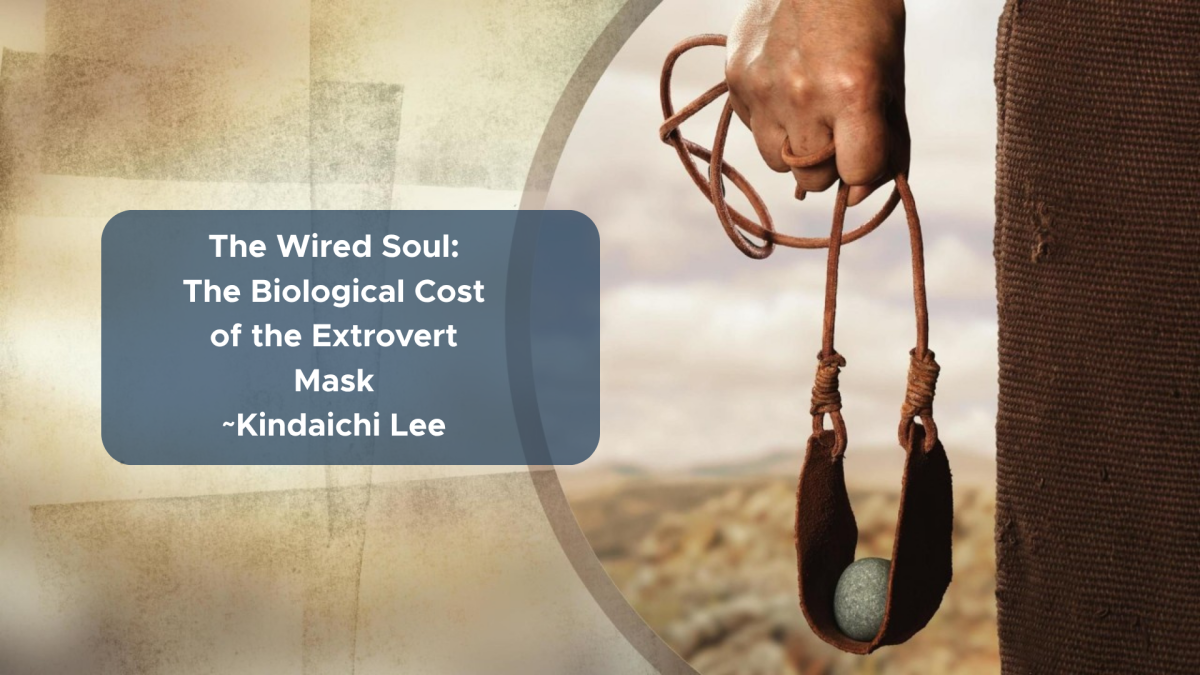
There is an old story about a young shepherd boy named David who is preparing to fight a giant named Goliath. The king, trying to be helpful, takes his own massive, heavy, bronze armour and straps it onto the boy.
David tries to walk, but he can’t move. The armour wasn’t made for him. It is too heavy. He takes it off, picks up his own simple slingshot, and wins the battle.
Your Ikigai is your slingshot. It is the exact, precise intersection of what you love, what you are good at, what the world needs, and what you can be paid for. It is tailored perfectly to your unique psychological fingerprint.
When you put on the Extrovert Mask, you are strapping on Saul’s armor. You are trying to fulfill your purpose using someone else’s tools.
You cannot find the center of your Ikigai while pretending to be someone else. Why? Because the world doesn’t need a second-rate extrovert. The world desperately needs a first-rate introvert.
If your Ikigai requires deep listening, structural thinking, and empathetic connection, but you spend your day forcing yourself to be the loudest voice in the room, you are violating your own design. You are misaligned. And your soul knows it.
The Engine (Neuroscience): The Tax of Allostatic Load
Now, let’s look under the hood at the engine. Why does “acting” make us so physically exhausted?
We tend to think of the brain as a computer that just processes thoughts. But the brain is a biological organ, and it is a massive energy hog. It accounts for about 2% of your body weight, but it consumes 20% of your metabolic energy (glucose and oxygen).
When an extrovert walks into a loud networking event, their brain is in its natural environment. It is running its default operating system. The energy expenditure is low.
But when an introvert puts on the Extrovert Mask, they are engaging in a psychological process called Surface Acting.
To perform Surface Acting, your brain has to boot up your prefrontal cortex (the conscious, executive control center) to manually override your natural instincts.
- Natural instinct:“I need a quiet corner to think.”
- Override command:“No, go talk to that group of strangers and smile broadly.”
Your brain is now running a massive, high-powered app in the background. It is constantly monitoring your behavior: “Am I smiling enough? Was I too quiet just now? Did I sound enthusiastic?”
This constant self-monitoring drains your brain’s glucose at an alarming rate.
But it gets worse. Because you are acting against your nature, your amygdala senses an incongruence. It interprets this psychological friction as stress. Your body releases a slow, steady drip of cortisol (the stress hormone) into your bloodstream.
In neuroscience, the chronic wear-and-tear that this prolonged stress puts on your body is called Allostatic Load.
Allostatic Load is the metabolic tax you pay for faking it. It causes systemic inflammation, disrupts your sleep cycle, impairs your memory, and completely depletes your emotional regulation reserves.
This is why you crash at 5:00 PM. Your brain didn’t run out of ideas; it literally ran out of metabolic energy trying to run the “Extrovert Simulation” program all day.
Authenticity is an Energy Strategy
When we understand the neuroscience of Allostatic Load, our entire perspective on “Authenticity” shifts.
Authenticity is not a fluffy HR concept designed to make everyone feel warm and fuzzy.
Authenticity is an energy-conservation strategy.
When you take off the mask, you close the background apps. You stop burning 40% of your cognitive glucose on self-monitoring. You stop the slow drip of cortisol.
Suddenly, that massive reservoir of metabolic energy is freed up. What can you do with it? You can use it to build better strategies. You can use it to listen deeply to your team (Level 3 Listening). You can use it to actually execute your Ikigai.
How to Unmask This Week
I am a realist. I know you cannot simply walk into your office tomorrow, declare that you are an introvert, and refuse to ever speak in a meeting again. Leadership requires adaptation.
But adaptation is temporary. Masking is chronic.
Here is your practical, brain-wiring application strategy to start lowering your Allostatic Load this week:
1. The Calendar Energy Audit
Look at your calendar for the next three days. Stop looking at it in terms of Time, and start looking at it in terms of Metabolic Energy.
Highlight the meetings or tasks where you know you have to wear the heavy armour—the high-stakes presentations, the forced networking, the chaotic brainstorms.
Do not schedule these back-to-back. If you have a high-masking hour, you must structurally pair it with a low-masking hour (deep work, reading, solitary planning) to let your glucose levels replenish and your cortisol drop.
2. The Pre-emptive Boundary (The User Manual)
The best way to avoid masking is to tell people how you operate before they expect a performance.
Write a simple “User Manual” for your leadership style and share it with your team.
Script: “To give you my best leadership, I need time to process data internally before I react. So, in our brainstorming meetings, I will likely be the quietest person in the room. I am not disengaged; I am processing. I will send you my strategic thoughts via email later that afternoon.”
When you declare your operating system, you no longer have to pretend to be the loud brainstormer. The mask comes off.
3. The Micro-Unmasking Experiment
Find one low-stakes environment this week where you usually fake extroversion. It might be the first five minutes of a Zoom call where everyone is doing forced small talk, or it might be an email where you normally add three exclamation points to sound “friendly.”
Try dropping the act. Just once.
Join the Zoom call, smile politely, and be completely comfortable with silence. Write the email using clear, direct language with periods instead of exclamation points.
Notice what happens. The world will not end. You will not be fired. But you will save a fraction of a percent of your battery. And those fractions add up.
Drop the Armour
In my upcoming book, Quiet Power: Leading with Impact, I wrote that the introverted leader’s greatest asset is their depth.
You cannot access your depth if you are exhausted from trying to skim the surface.
You have a unique Ikigai. The world needs the exact combination of empathy, observation, and structural thinking that you naturally possess. Do not rob your team, your clients, or your family of your true gifts because you are trying to act like a Gladiator.
Take off Saul’s armour. It doesn’t fit you anyway.
Pick up your slingshot. Reclaim your energy. Step into your Quiet Power.
Until next week, lead as yourself.