
The Boardroom Family: Generational Trauma in the Workplace (The Ghost in the Room)
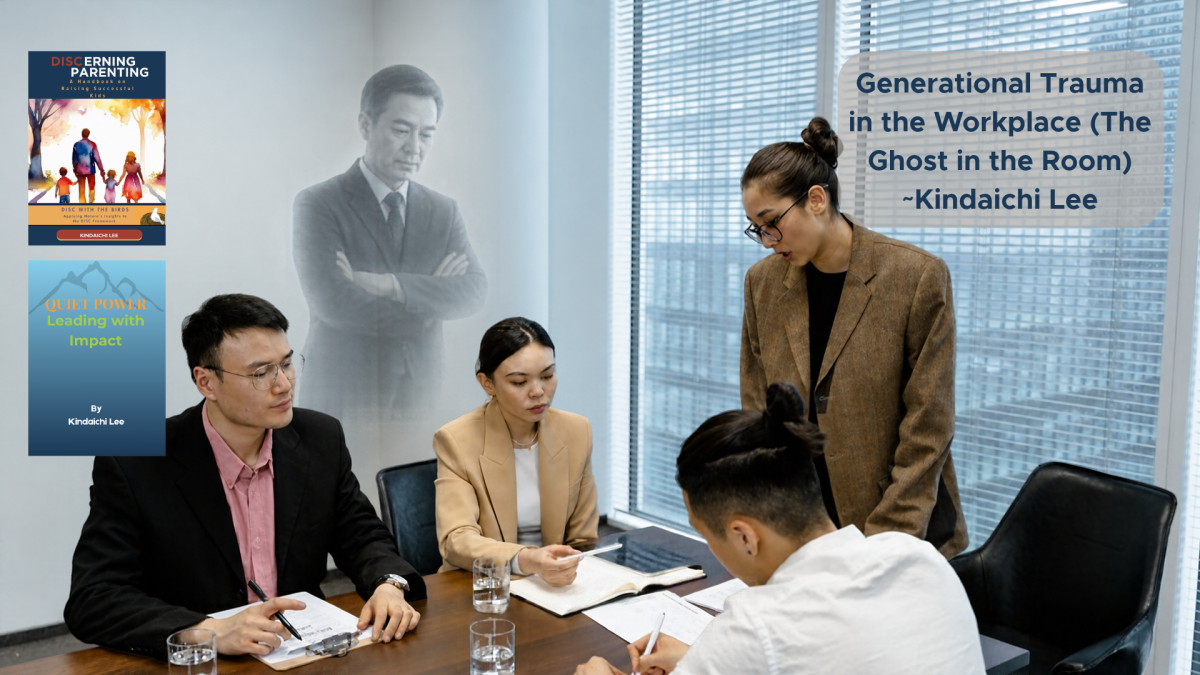
(EI & Relationship Mastery Newsletter – Season 8, Article 4)
Imagine you take over a new team. You are a calm, calibrated, quiet leader. You value autonomy, you trust your people, and you hate micromanaging.
But within your first two weeks, you notice something strange. Your team is acting incredibly weird. They CC you on every single mundane email. If a minor mistake happens, they hide it, point fingers, and launch into defensive, thousand-word explanations before you even have a chance to ask what went wrong. In meetings, no one speaks until you speak first.
You haven’t done anything to make them fear you. So why are they acting like they are under attack?
Welcome to Week 4 of Season 8: The Boardroom Family.
We are halfway through our season applying Family Systems Therapy to the C-Suite. Today, we are looking at a phenomenon that completely derails well-meaning leaders.
We are looking at Generational Workplace Trauma, and how to exorcise the ghost in the boardroom.
The Cliché: “It’s a Fresh Start”
In the corporate world, when a toxic manager is finally fired, or when a company goes through a massive restructuring, the HR department usually sends out an email talking about a “fresh start” and a “clean slate.”
But as a Family Counsellor, I can tell you this: There is no such thing as a clean slate. The body keeps the score.
In family therapy, generational trauma occurs when the survival mechanisms adapted by one generation (like extreme frugality born from a historical depression, or emotional withdrawal born from conflict) are passed down to the next generation, long after the original threat is gone.
The exact same thing happens in a business ecosystem.
When a team spends three years working under a volatile, micromanaging “Gladiator” boss who publicly shamed people for making mistakes, their nervous systems adapt. To survive, they learn to hide errors. They learn to CC the boss on everything to create a paper trail of innocence. They learn to keep their heads down.
When that toxic boss leaves and you step in, the threat is technically gone. But the trauma responses remain.
The toxic boss is the Ghost in the Room. They are no longer on the payroll, but their rules are still secretly dictating how your team behaves today.
The Illusion of Logic
Most new leaders try to solve this with logic. They stand up in a meeting and say, “Guys, I’m not like the last boss. You can trust me. My door is always open.”
They expect the team to instantly relax. But logic does not cure trauma.
When you tell a traumatised corporate family to “just trust you,” their amygdalas don’t believe you. In DISCerning Parenting, I talk about how you cannot logic a terrified child out of a fear response; you have to physically prove that the environment is safe through repeated, consistent action.
The same applies to your team. They don’t know your rules yet. They only know the Ghost’s rules. And until you explicitly drag those old, invisible rules into the light and dismantle them, your team will continue to operate in survival mode.
The Experiential Lab: The “We Used To / Now We” Mapping
To get rid of a ghost, you have to name it. You have to explicitly acknowledge the old trauma, validate why the team developed those survival habits, and then architect a new narrative.
This week’s lab is the “We Used To / Now We” Transition Mapping.
Do this exercise with your team (or even just for yourself if you are trying to unlearn old habits from a past toxic job). It takes 15 minutes, and it changes the neurochemistry of the room.
Step 1: Name the Survival Habit Take a whiteboard or a shared document. Acknowledge a specific, unhelpful behavior you see happening.Script: “I’ve noticed we spend a lot of time CCing everyone on routine updates, and people seem really anxious when a minor deadline slips.”
Step 2: Map “We Used To” (Validate the Past) Do not shame them for the habit. Validate it as a smart survival tool from the past regime.Write: WE USED TO… operate in an environment where mistakes were punished publicly, so we CC’d everyone to protect ourselves.
Step 3: Map “Now We” (Architect the Present) Draw a line. Write out the new rule for the current ecosystem.Write:NOW WE… operate in an environment where mistakes are treated as data.
Step 4: The New Protocol Define the exact, physical action that replaces the old trauma response.Write: PROTOCOL:Stop CCing me on daily updates. If a mistake happens, bring it to the weekly Campfire meeting. You will never be shamed for an honest error in this room.
When you write it down and explicitly bridge the gap between the past and the present, the team can finally exhale. You give their nervous systems permission to put down the armour they’ve been wearing for years.
You hold the pen. Don’t let a ghost write your team’s culture.
Until next week, keep building the family.