
De-escalation via The Still-Point: Dictating the Weather of the Room
(EI & Relationship Mastery Newsletter – Season 5, Article 4)
Good afternoon from Kuala Lumpur.
Welcome back to Season 5: “The Conflict Architect.”
Over the past three weeks, we have been completely rebuilding our approach to workplace friction. We discarded the “Gladiator” mindset (fighting to win) and adopted the “Architect” mindset (observing to fix). We learned how to override the biological urge to flee using the 24-Hour Rule, and we explored how to anticipate fires before they start using the Pre-Mortem.
But what happens when the fire is already burning?
What happens when you walk into a meeting, and the room is already hot? Egos are bruised, voices are raised, and the professional masks have slipped. Two department heads are shouting. A client is making unreasonable, aggressive demands. The air is thick with cortisol.
In these moments, human biology dictates a very specific response. Thanks to our mirror neurons, emotions are contagious. When someone yells at us, our instinct is to match their volume. When someone leans in aggressively, we either cower, or we puff up our chests to meet the threat.
We act like thermometers. We simply reflect the temperature of the room.
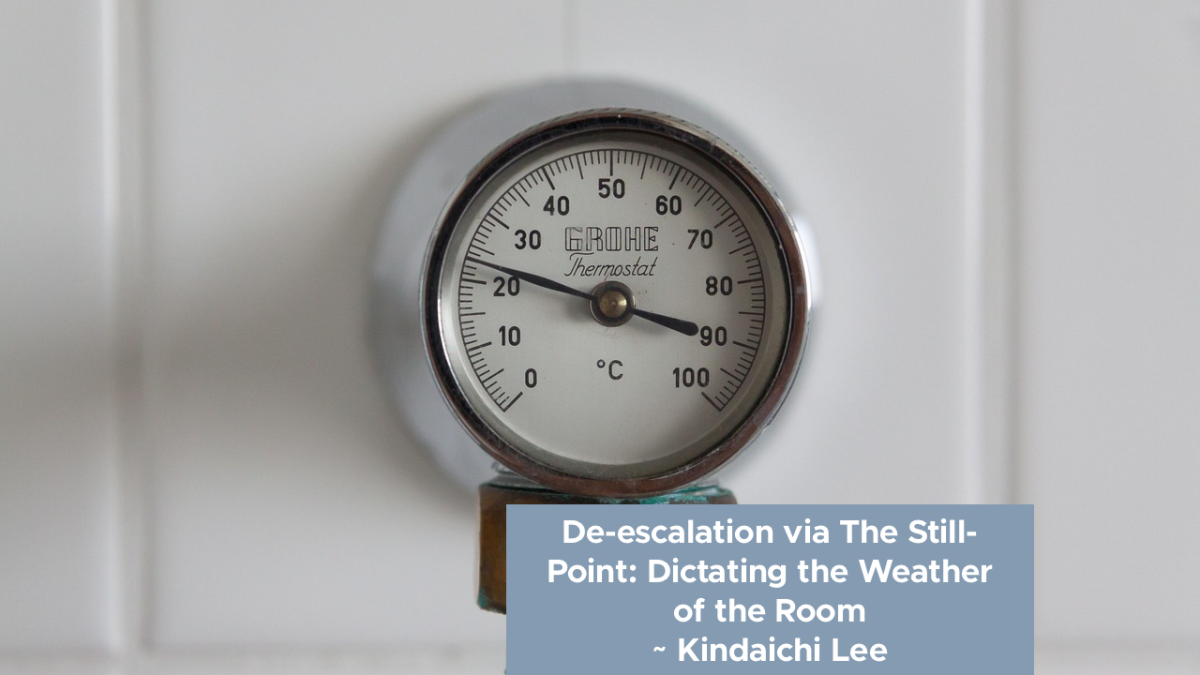
But a true Conflict Architect—a leader wielding Quiet Power—does not reflect the temperature. They set it. They act as the thermostat.
Today, we are going to explore a masterclass in introverted conflict resolution: De-escalation via The Still-Point.
We will explore how your visible, grounded calmness can act as a gravitational force, pulling an agitated team out of their panic and forcing them to lower their baseline anxiety. You will learn how to stop matching the noise and start dictating the weather of the room.
The Physics of a Shouting Match
To understand how to de-escalate a room, you first have to understand the physics of an escalation.
Think of anger as a form of kinetic energy. When a colleague gets aggressive, they are throwing that energy across the table at you. They are subconsciously looking for a wall to bounce that energy off of.
If you get defensive, raise your voice, and argue back, you become that wall. The energy bounces back and forth, amplifying with every exchange. The room gets hotter. The conflict escalates.
But what happens if they throw that energy, and there is no wall? What happens if they throw a punch, and it lands in open air?
The energy dissipates. The aggressor loses their balance.
For the introverted leader, engaging in a shouting match is a losing proposition. We do not have the immediate verbal processing speed or the extroverted energy reserves to win a high-volume war of words. If we step into the Gladiator arena, we will leave exhausted and defeated.
Our greatest weapon in a hot room is not a louder voice. It is an immovable, unshakeable calm.
In Quiet Power, I refer to this as The Still-Point. It is a state of internal emotional regulation so deep and so visible that it forces the people around you to regulate themselves just to interact with you.
The Case Study: The Boardroom Blizzard
Let me introduce you to “Thomas.”
Thomas was the VP of Supply Chain for a mid-sized manufacturing company. He was a classic introvert—soft-spoken, deeply analytical, and highly observant.
The company was facing a massive crisis. A key supplier in China had gone bankrupt, delaying a flagship product launch by three months. The executive team was called into an emergency meeting.
The room was a powder keg. The VP of Sales, a high-strung extrovert named “Mark,” was losing his mind. His team’s commissions were tied to this launch.
The moment Thomas walked in, Mark attacked.
“This is a disaster, Thomas!” Mark yelled across the boardroom table, slamming his notebook down. “Your team completely dropped the ball! We are going to lose our biggest retail accounts because your people didn’t have a contingency plan! What are you going to do to fix this right now?!”
Everyone in the room froze, holding their breath, looking at Thomas.
The “Action Hero” response would be for Thomas to yell back, defend his team, and blame Mark’s sales forecasts for straining the supply chain. That would have ignited a full-blown war.
Thomas did the exact opposite. He went to his Still-Point.
Deploying the Quiet Power Tools
Thomas deployed two specific tools that we discussed in Season 4, but this time, he used them defensively.
1. The Anchor Breath (Physiological De-escalation)
While Mark was yelling, Thomas felt his own heart rate spike. His “Flight” response wanted him to leave; his “Fight” response wanted him to scream.
Instead, Thomas placed both of his hands flat on the boardroom table. He planted his feet on the floor. He took one deep, slow breath in through his nose, expanding his diaphragm, and exhaled slowly.
He physically grounded his body. He signalled to his own nervous system: I am safe. I am in control. ####
2. Defensive Strategic Silence (The Echo Chamber)
When Mark finished his rant, demanding an immediate fix, Thomas did not answer right away.
He held eye contact with Mark. His face was entirely neutral—not angry, not frightened, just observant. He let the silence stretch for three, four, five seconds.
In Season 4, we used the “Heavy Pause” to command authority in a negotiation. Here, Thomas used Defensive Silence.
When someone is shouting, they are filled with adrenaline. When you meet their shout with total silence, their words echo in the room. They suddenly hear how loud, aggressive, and out of control they sound. The silence strips away their momentum. It creates a psychological vacuum that drains the aggression from the room.
Mark shifted uncomfortably in his chair. The silence was suffocating him. “Well?” Mark muttered, his volume dropping by 50%. “What’s the plan?”
3. The “Low and Slow” Frequency
When Thomas finally spoke, he did not match Mark’s high pitch or rapid cadence. He did exactly the opposite.
He lowered the pitch of his voice by half an octave. He slowed his rate of speech by 20%.
“Mark,” Thomas said calmly, his voice steady and resonant. “I understand the financial gravity of this delay for your team. The frustration is entirely justified.”
Thomas paused again, letting the validation sink in.
“However,” Thomas continued, maintaining the slow, rhythmic cadence, “panic will not manufacture the raw materials. I have my team modeling three alternative supply routes as we speak. I need 48 hours to secure the logistics and present a viable timeline. Until then, pointing fingers will only distract us from the solution.”
Dictating the Weather
Notice the profound shift in the room’s dynamic.
Thomas did not try to shout over the storm; he simply refused to participate in it.
By grounding himself (The Anchor Breath), absorbing the aggression without reflecting it (Defensive Silence), and speaking with deliberate, measured pacing (Low and Slow), Thomas forced the entire room to adapt to his frequency.
If Mark wanted to continue the conversation, he had to stop yelling. Why? Because if one person is speaking softly and slowly, you look like a maniac if you keep screaming at them. You literally have to lean in and quiet down just to hear them.
Thomas acted as the thermostat. He dictated the weather of the room. He brought the temperature down from a boiling panic to a cool, operational focus.
The meeting ended not with a fight, but with a clear action plan. Thomas saved his team’s reputation, not by fighting, but by refusing to fight on the Gladiator’s terms.
How to Build Your “Still-Point” This Week
De-escalating a hot room is a superpower, but it is not magic. It is a biological and psychological technique that you can practice.
Here is your application strategy for this week:
1. Master the “Low and Slow” Rule
In your next meeting, if you sense the conversation getting tense or hurried, consciously do the opposite. Lower the pitch of your voice slightly. Slow down your words. Add deliberate pauses between your sentences. Watch how the people around you subconsciously mirror your calmness. You are retraining their nervous systems with your own.
2. Practice the “Defensive Pause”
The next time someone sends you a heated message, or challenges you aggressively in a conversation, do not defend yourself immediately. Count to three in your head. Look at them neutrally. Let their aggressive energy land in open air. Only speak when you feel your own heart rate is stable.
3. Separate the Emotion from the Data
When someone is yelling, they are handing you a tangled ball of emotion and data. The Gladiator reacts to the emotion. The Architect extracts the data.
If someone says: “Your team is completely incompetent and this project is a disaster!”
- The Emotion: They are angry and afraid.
- The Data: The project is off-track.
The Anchor in the Storm
As an introverted leader, you do not need to be the loudest voice in the room to have the most authority. In fact, in times of crisis, noise is the last thing people need.
People need an anchor. They need someone who is so deeply rooted in their own conviction and calmness that the storm breaks around them.
When the room gets hot, do not match the heat.
Go to your Still-Point. Drop your volume. Hold the silence.
Let them realize that you cannot be moved by noise.
Until next week, dictate the weather.
Kindaichi Lee, Your Transformative Storyteller 🎬