
The Wired Soul: The Biology of the Guilt Hangover (Why Saying ‘No’ Feels Like a Threat)
(EI & Relationship Mastery Newsletter – Season 6, Article 5)
Good afternoon.
If you scroll through LinkedIn for more than three minutes today, you are guaranteed to see a post about boundaries.
“Just say no!” “Protect your peace!” “Your time is your most valuable asset!”
It’s the most common piece of productivity advice on the internet. And frankly, it is the most frustrating. Because for a quiet leader, an empathetic team member, or anyone who deeply values connection, saying “no” to a boss, a client, or a partner doesn’t feel empowering.
It feels terrifying.
Welcome back to Week 5 of Season 6: The Wired Soul.
We are continuing to decode the most exhausting leadership clichés using Ikigai as our Compass and Neuroscience as our Engine. Today, we are dismantling the cliché of “just setting boundaries.”
We are going to look under the hood at why drafting an email turning down a request makes your heart race and your palms sweat. We will look at the biological reality of the Amygdala Hijack, and how to hack your nervous system so you can protect your time without suffering a massive guilt hangover.
The Engine (Neuroscience): The Amygdala Hijack
Why is it so physically difficult to say no?
It isn’t a lack of courage. It isn’t a character flaw. It is pure, evolutionary biology.
Let’s look at the engine. For millions of years, human beings survived because we lived in cooperative tribes. A solitary human on the savannah did not last long. In our mammalian brain, social inclusion equals survival, and social rejection equals death.
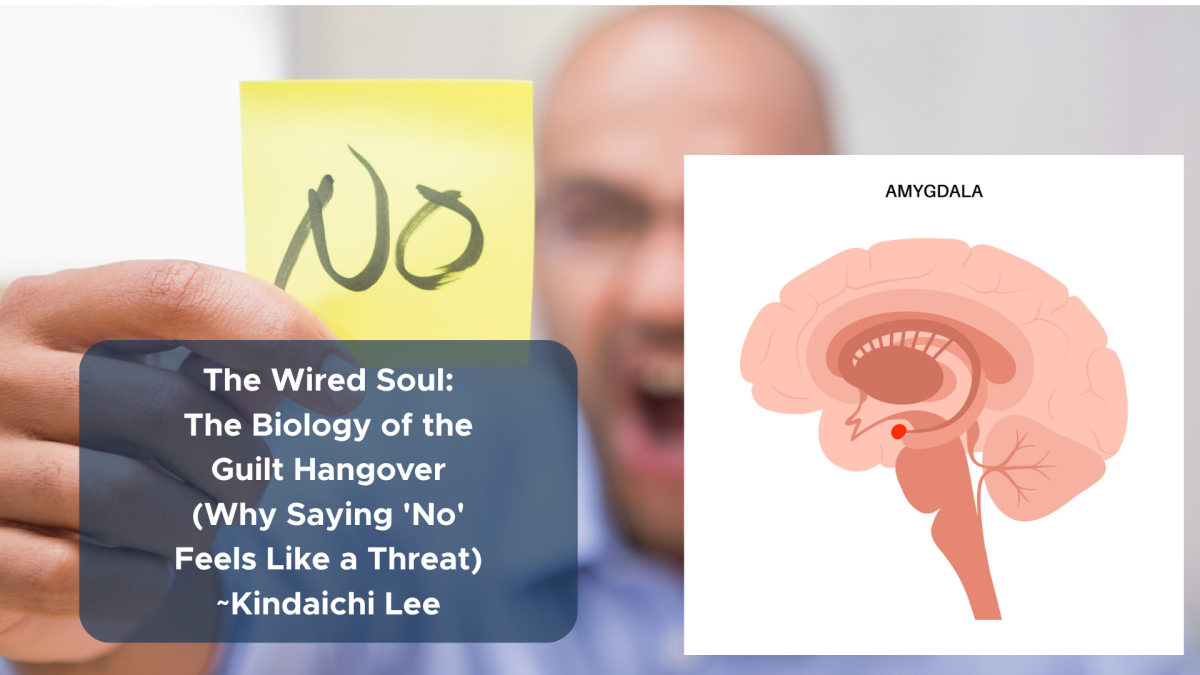
Deep inside your brain sits Amygdala, an almond-shaped cluster of neurons that acts as your internal alarm system.Its entire job is to scan the horizon for threats and trigger a fight-or-flight response to keep you alive.
When your boss asks you to take on an extra project on a Friday afternoon, and you think about saying”No, my plate is full“, your logical prefrontal cortex knows this is a reasonable boundary. But your amygdala doesn’t care about reason. It sees a potential conflict. It sees the possibility of disappointing the leader of your tribe. It interprets this social friction as a survival threat. In a fraction of a second, the amygdala hijacks your brain. It bypasses your logical prefrontal cortex and floods your bloodstream with cortisol and adrenaline. Your heart rate spikes. Your chest tightens. This is the Amygdala Hijack.
Neuroscience backs this up with stunning clarity. Studies have shown that the pain of social rejection activates the exact same regions in the brain (like the dorsal anterior cingulate cortex) as physical injury.
As far as your nervous system is concerned, a broken boundary is safer than a broken relationship. When you say no, it literally, biologically hurts.
The Compass (Ikigai): Protecting the Forge
If saying no hurts our biology this much, why do we have to do it?
Because if you don’t, you will destroy your Ikigai.
We often think of boundaries as concrete walls built to keep people out. That is the wrong metaphor. A boundary is not a wall to keep people out; it is a fence built to keep your purpose safe.
Every time you say “yes” to a project that drains you, to an unaligned client, or to a meeting that steals your deep work time, you are spending metabolic glucose. You are stealing energy from the “What You Love” and “What the World Needs” circles of your Ikigai to pay off the anxiety of your amygdala.
I see this pattern repeat endlessly. In the counselling room, I sit across from parents and partners who are so exhausted from saying “yes” to everyone else that they have nothing left for the people they actually love. It was a central theme when I wrote DISCerning Parenting—you cannot raise a healthy system, at home or at work, if the architect is chronically depleted.
You cannot pour from an empty cup. Saying “no” to the wrong thing is the only structural way you can create the capacity to say “yes” to your true purpose.
How to Hack the Hijack This Week
You cannot stop the amygdala from firing. But you can hack the timeline so you don’t have to make decisions while you are hijacked.
Here is your practical, brain-wiring application strategy for setting boundaries without the guilt hangover this week:
1. The 24-Hour Reflex (The Space Between)
Never answer a request in the room. When the request is made, your amygdala is flooded. You must create a structural delay to let your prefrontal cortex come back online.
Memorise this reflex script: “That sounds like a great initiative. Let me check my commitments and my calendar, and I will get back to you by tomorrow morning.”
You haven’t said no, so the amygdala doesn’t panic. But you have bought yourself the 24 hours you need to look at your Ikigai compass and make a logical decision.
2. The “Positive No” Architecture
When you do say no, do not reject the person. Reject the task. Protect the relationship while holding the line.
Script: “I want this project to succeed, and because my bandwidth is currently fully allocated to the Q3 launch, I cannot give this the attention it deserves right now. Therefore, I have to decline, but I am rooting for the team.”
This signals to their nervous system (and yours) that you are still part of the tribe; you are just managing resources.
3. Normalize the 10-Minute Hangover
When you hit “send” on that email, you are going to feel a spike of guilt. Your heart will race.
Do not try to fix it. Do not send a follow-up email apologising.
Accept that it will feel physically uncomfortable for about 10 minutes. Sit with it. That 10 minutes of biological anxiety is simply the toll you pay to avoid three months of burnout. The cortisol will flush out of your system, and the peace of a protected boundary will replace it.
Hold the Line
Setting boundaries is not about being cold, distant, or unhelpful.
It is about having the quiet conviction to realise that your energy is finite, and your purpose is important. You are a storyteller, a builder, a parent, a leader. You need your forge protected.
The next time someone asks for a piece of your time you cannot spare, expect the knot in your stomach. Welcome the alarm bell. But do not let it drive the car.
Take a breath. Check your compass. Hold the line.
Until next week, keep your forge safe.