
The Introvert’s Flight Response: Why We Run from Conflict (And How to Override It)
(EI & Relationship Mastery Newsletter – Season 5, Article 2)
Good morning.
Last week, we opened Season 5 of our newsletter, “The Conflict Architect,” by changing the rules of engagement. We established that as introverted leaders, we should not try to be Gladiators entering an arena to fight. We must be Architects entering a site to fix a structural flaw.
But today, we need to be incredibly honest with each other. We need to address the elephant in the room.
Before an Architect can fix a building, they actually have to walk inside it.
And if we are completely candid, when the walls of a team start shaking—when voices raise, when passive-aggressive emails fly, when egos clash—the first instinct for many introverted leaders is not to pull out the blueprints.
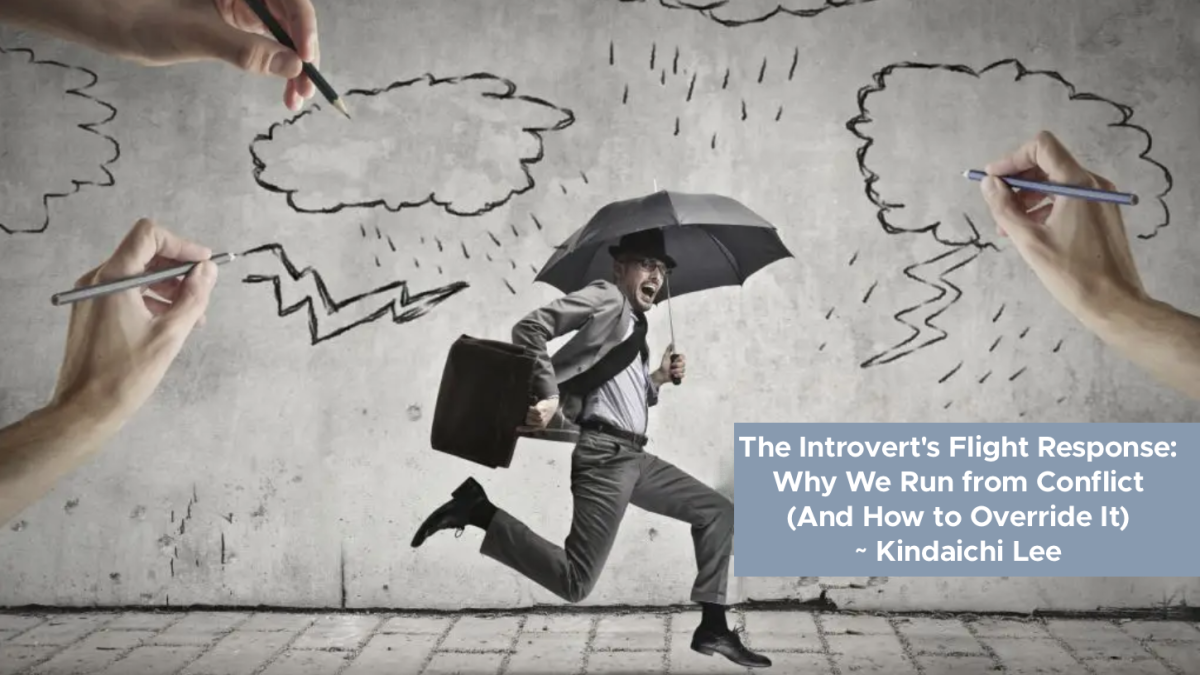
Our first instinct is to run out the back door.
We avoid the conversation. We soften the feedback until it means nothing. We tell ourselves, “It’s not a big deal, I’ll just fix the work myself.” We pretend we didn’t hear the sarcastic comment.
This week, we are looking at The Introvert’s Flight Response.
We will break down the biological reasons why conflict feels so devastating to our nervous systems, the hidden and terrible cost of maintaining “Artificial Harmony,” and most importantly, how to use a specific Quiet Power tool to override the urge to flee.
The Biology of the Urge to Flee
If you feel a knot in your stomach the moment a meeting turns hostile, you are not weak. You are experiencing a biological response.
Introverts generally have a lower threshold for external stimulation. Our brains process information deeply, routing it through long, complex neural pathways. When a conflict erupts, it is like a massive surge of electricity hitting a delicate circuit board.
- The Cortisol Flood: When someone is angry or aggressive, our amygdala (the brain’s threat-detection center) fires. Cortisol and adrenaline flood our system.
- The Processing Freeze: Because we process internally, we need time to make sense of the new, aggressive data. But the “Gladiator” across the table is demanding an immediate answer. This mismatch causes a cognitive freeze. We literally cannot find our words.
- The Energy Drain: Managing our own spiked emotions, while simultaneously trying to interpret the other person’s erratic behaviour, drains our social battery in minutes.
Our brain does a rapid calculation: This situation is draining my battery to zero and I cannot process the data fast enough. Solution: ESCAPE.
We flee. We agree to a bad compromise just to end the meeting. We say, “You’re right, let’s just move on.”
We survive the moment, but we sacrifice the leadership.
The Toxic Trap of “Artificial Harmony”
When we let the Flight Response dictate our leadership, we create a culture of Artificial Harmony.
Artificial Harmony looks peaceful on the surface. There is no yelling. There are no dramatic boardroom showdowns. Everyone smiles on the Zoom calls.
But underneath, the foundation is rotting.
Because we avoided the difficult conversation:
- Standards Drop: The underperforming employee assumes their work is acceptable because you never gave them the hard feedback.
- Resentment Builds: The high-performers on your team become bitter because they have to pick up the slack for the under-performer you refuse to confront.
- Innovation Dies: People stop challenging bad ideas because “keeping the peace” is valued more than finding the truth.
Artificial Harmony is a lie. It is peace purchased at the cost of truth.
As a leader, your job is not to make sure everyone is comfortable. Your job is to make sure the team is effective. And effectiveness requires friction. You cannot polish a diamond without friction. You cannot build a great product, a great culture, or a great relationship without the willingness to sit in the discomfort of a disagreement.
The Quiet Power Tool: The 24-Hour Rule
So, how do we fix this? If our biology is screaming at us to run, how do we stay in the room?
We don’t.
We change the timeline.
The greatest mistake introverts make in conflict is believing that we have to resolve the issue the exact moment it happens. We think that if we don’t have the perfect comeback or the perfect solution right then and there, we have failed.
You do not have to fight on their timeline. You can use The 24-Hour Rule.
The 24-Hour Rule is a structured delay. It is not avoidance. Avoidance is hoping the problem goes away. A structured delay is putting a pin in the problem so you can process it and return with your Architect Mindset fully engaged.
Here is how it works:
Step 1: The Anchor Phrase
When a conflict flares up and you feel the Flight Response kicking in (your heart races, your mind goes blank), do not try to solve it. Deploy a pre-memorised anchor phrase.
- Script: “This is a critical issue, and tensions are high right now. I am not going to make a decision or give feedback on this in the current dynamic. I am pausing this conversation, and we will reconvene tomorrow at 10:00 AM to resolve it.”
Step 2: The Biological Reset
Walk away. You have successfully removed yourself from the overstimulating environment. Your amygdala will cool down. Your prefrontal cortex will come back online. You have protected your battery.
Step 3: The Architect’s Preparation
Now that you are in your Still-Point, look at the blueprint of the conflict.
- What is the actual structural flaw here?
- What are the facts, separated from the emotion?
- What is the outcome I need to achieve tomorrow?
Step 4: The Deliberate Return
At 10:00 AM the next day, you initiate the meeting. This is crucial. You must be the one to reopen it. This proves it was a structured delay, not cowardice.
Because you are calm, prepared, and no longer in “Flight” mode, you dictate the weather of the room. You bring Quiet Authority.
The Case Study: The Vendor Who Wouldn’t Listen
I coached a Director of Marketing named “Sarah.” She was managing a creative agency that was consistently delivering work late and ignoring her brand guidelines.
Sarah hated conflict. Every time she got on a call with the agency’s loud, aggressive Account Manager, she froze. The Account Manager would talk over her, make excuses, and bulldoze the agenda. Sarah would experience the Flight Response. She would say, “Okay, just try to get it right next time,” and hang up, feeling defeated.
Her team was suffering because the agency was holding up their campaigns. They were living in Artificial Harmony.
We deployed the 24-Hour Rule.
The next time the agency delivered a sub-par campaign, Sarah didn’t call the Account Manager immediately while she was angry and overwhelmed.
She waited 24 hours. She wrote down exactly what brand guidelines were violated. She wrote down the financial cost of the delay. She prepared her Linguistic Scalpel.
She scheduled a call for the next day.
When the Account Manager started to make excuses and raise his voice, Sarah didn’t flee. She was prepared.
She said, “I am stopping you there. We are not debating the excuses. The structural problem is that the guidelines were ignored. Here is the data. Moving forward, if a draft does not meet these three criteria, the invoice will not be paid. Do we have a clear understanding of this structure?”
The Account Manager was stunned by her calm, immovable boundary. The dynamic shifted entirely. The work improved immediately.
Sarah didn’t win by yelling louder. She won by overriding her urge to flee, giving herself time to process, and returning as the Architect.
Building the Tolerance for Discomfort
The 24-Hour Rule is your emergency brake. But over time, you want to build your tolerance so you don’t always need it.
Think of conflict tolerance like a muscle. If you have avoided it your whole life, that muscle has atrophied. You cannot start by bench-pressing 300 pounds (confronting your CEO about a major strategic failure). You have to start with 5-pound weights.
Your Micro-Exposure Challenge:
This week, I want you to practice sitting in minor discomfort without fleeing.
- If a colleague suggests an idea in a meeting that you disagree with, do not just nod to keep the peace.
- Say: “I see it slightly differently. Let’s look at the data on that.”
- Then, just sit there. Let the mild tension exist in the air. Do not apologize. Do not back down. Just observe that the world does not end because you disagreed.
Every time you do this, you rewrite the neural pathway that says Conflict = Danger. You begin to teach your brain that Conflict = Data.
The Courage to Stay
It takes immense courage for an introverted leader to stay in the room when everything in their body is screaming to leave.
But true leadership is not found in the comfortable silence of Artificial Harmony. It is found in the messy, uncomfortable, necessary friction of truth.
You do not have to be a Gladiator. You do not have to enjoy the fight.
But you must stop running from the building.
Grab your blueprints. Take a breath. Take 24 hours if you need it.
Then step back into the room and build something better.
Until next week, stay in the fire.
Kindaichi Lee, Your Transformative Storyteller 🎬