
Leading from Within: Authenticity as the Cornerstone of Quiet Power
Good morning from Kuala Lumpur.
I want to start this week by asking you a question that might feel a little uncomfortable.
How much energy did you spend last week pretending to be someone else?
Think about that Monday morning meeting. Did you force a high-energy “Good morning!” when you really wanted to slide quietly into your seat with your coffee?
Think about that networking event. Did you force yourself to be the “life of the party,” laughing loudly at jokes you didn’t find funny, just to fit in?
Think about that crisis moment. Did you try to bark orders like a drill sergeant because that’s what you thought a “strong leader” looked like, even though your natural instinct was to go quiet and think?
We have a name for this. It’s called “masking.” It is the exhausting, soul-crushing performance of trying to twist your introverted shape into an extroverted hole.
For the past eight weeks, we have been building a cathedral of “Quiet Power.” We have explored the Still-Point, the Empathetic Edge, the Strength in Serenity, the Depth Charge, the Linguistic Scalpel, the Curator of Talent, the Marathon Mindset, and the Power of the Pause.
But a cathedral needs a cornerstone. Without it, the walls—no matter how beautiful—will eventually collapse.
Today, we place that cornerstone. It is Authenticity.
This week, we explore the most critical truth of all: The most potent leadership does not come from mimicking an extroverted ideal. It comes from embracing, owning, and leveraging your introverted nature. It comes from leading from within.
The High Cost of the “Chameleon Leader”
We live in a culture that worships the Gladiolus—the loud, charismatic, high-visibility leader. Because of this, many introverts grow up believing that their natural personality is a defect to be corrected. We are told to “speak up,” “come out of our shells,” and “fake it ‘til we make it.”
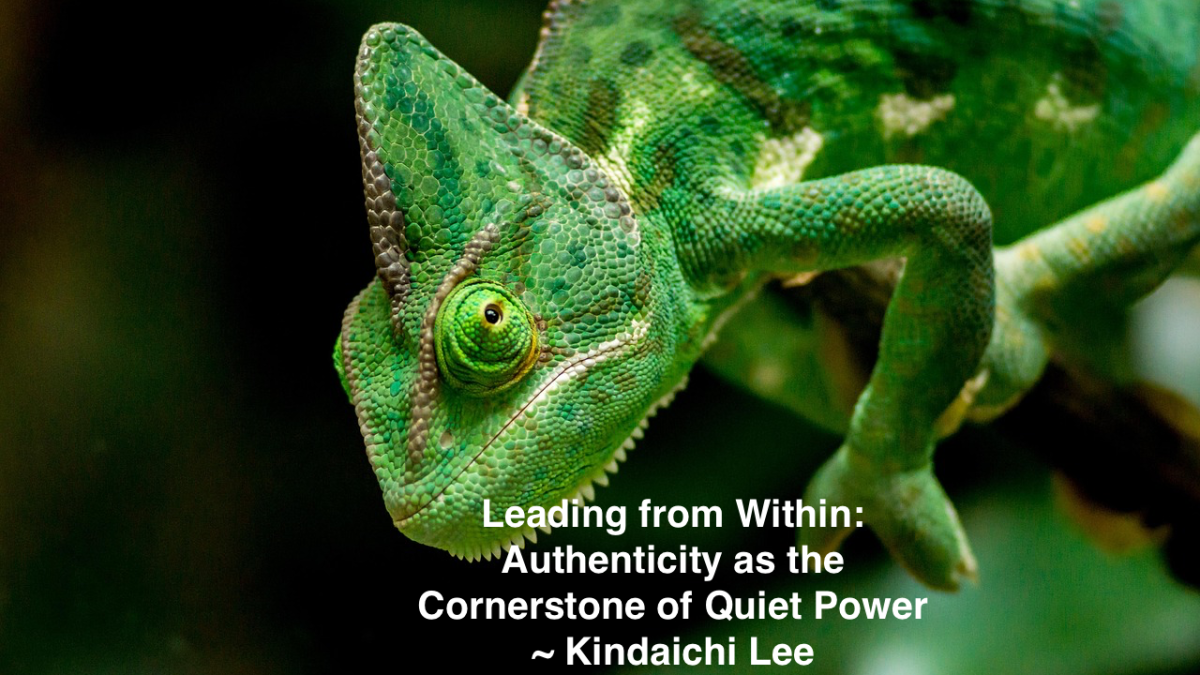
So, we become Chameleons. We learn to mimic the behaviours of the extroverts around us. And for a while, it works. We get the promotion. We get the applause.
But there is a tax. I call it the “Acting Tax.”
Every minute you spend acting like an extrovert is a minute you are burning cognitive fuel. The brain cannot focus on complex strategy, deep listening, or empathetic connection if 50% of its bandwidth is dedicated to maintaining a character.
- The Fatigue: This is why you go home completely drained, not by the work, but by the performance of the work.
- The Disconnect: When you are acting, you are not present. You are monitoring your performance. You cannot truly connect with your team if you are constantly watching yourself from the outside.
- The Trust Gap: This is the most dangerous cost. Humans are incredibly intuitive lie detectors. Even if your “act” is polished, people can sense the dissonance. They sense that you are not fully comfortable in your own skin. And if they can’t see the real you, they cannot fully trust you.
You cannot lead powerfully if you are exhausted, disconnected, and distrusted. The Chameleon strategy is a dead end.
Defining Authenticity: It’s Not About “Letting It All Hang Out”
Before we go further, let’s clarify what I mean by authenticity. In the context of leadership, authenticity does not mean “having no filter.” It doesn’t mean telling your team all your insecurities or refusing to stretch yourself socially because “that’s just not me.”
Authenticity, in the realm of Quiet Power, means Alignment.
It means aligning your external actions with your internal values and strengths.
- It means that when you speak, you speak with your own voice, not a borrowed one.
- It means that when you lead, you lead from your own center of gravity.
- It means acknowledging your needs (like solitude and reflection time) and treating them not as weaknesses to be hidden, but as requirements for your peak performance.
When an introverted leader stops apologising for who they are and starts leaning into it, a shift happens. They stop vibrating with anxiety and start vibrating with authority.
The Three Pillars of Authentic Quiet Leadership
So, how do we strip away the mask? How do we stop mimicking and start leading? In my book “Quiet Power: Leading with Impact,” I outline three pillars of this transition.
Pillar 1: Owning Your Rhythm (Energy Management)
The Extrovert Ideal says a leader should have an “Open Door Policy” 24/7. They should be available, visible, and constantly interacting. For an introvert, this is a recipe for burnout.
The Authentic Introvert owns their rhythm. They realise that to be effective, they need to protect their energy.
- The Shift: Instead of a perpetually open door, they might have “Office Hours” where they are fully available, and “Deep Work” hours where the door is closed.
- The Communication: They don’t hide this. They explain it. “I want to give you my best thinking. To do that, I need quiet time between 9 AM and 11 AM. During that time, I am offline. After 11, I am all yours.”
This isn’t selfish; it’s strategic. By owning your need for solitude, you ensure that when you are with your team, you are fully charged, present, and patient. You are giving them the best of you, not the rest of you.
Pillar 2: Owning Your Voice (Substance Over Volume)
The Extrovert Ideal says a leader should “think out loud” and dominate the brainstorming session.
The Authentic Introvert owns their need for processing time. They stop trying to win the race to speak first.
- The Shift: They use the Power of the Pause. They say, “I have some thoughts on this, but I want to process the data first. I will send you a memo by the end of the day.”
- The Communication: They reframe their silence. “If I’m quiet in this meeting, it’s not because I’m disengaged. It’s because I’m listening to make sure I understand all the angles.”
When you stop scrambling to fill the silence with fluff, your actual words gain weight. You train your team to value your Linguistic Scalpel, not your noise.
Pillar 3: Owning Your Vulnerability (The Human Connection)
The Extrovert Ideal often projects an image of invulnerability and constant high energy.
The Authentic Introvert connects through humanity. They are willing to admit what they don’t know. They are willing to show up as a “whole person.”
- The Shift: Instead of faking confidence in a crisis, they use the Strength in Serenity. They admit the challenge but project calm resolve.
- The Communication: “I’m not the kind of leader who is going to give you a rah-rah speech every morning. But I am the kind of leader who will always have your back and will always listen to you.”
Narratives of the Unmasked Leader
The transition from Chameleon to Authentic Leader is often the turning point in a career.
Story 1: The CEO Who Stopped Pretending
I coached a CEO named Marcus. He ran a mid-sized tech company. Marcus was a deep introvert, a Map Maker and Deep Diver. But he thought a CEO needed to be Steve Jobs or Tony Robbins.
He spent years trying to be the “Visionary Showman.” He staged elaborate town halls with loud music. He tried to be charismatic and funny. He was exhausted, and worse, his team felt disconnected. They saw him as “salesy” and inauthentic. The company was stalling.
One day, Marcus hit a wall. He couldn’t do the act anymore. He decided to try leading as himself.
At the next town hall, he cancelled the music. He sat on a stool in the middle of the stage. He didn’t use a teleprompter. He held a notebook.
“I want to try something different today,” he said quietly. “I’m not a showman. I’m an engineer. I love this company because I love solving hard problems. And right now, we have some hard problems.”
For the next hour, he didn’t hype them up. He walked them through the data. He shared his worries. He explained his strategic thinking with the precision of a Linguistic Scalpel. He treated them like adults. He treated them like peers.
The room was dead silent—not out of boredom, but out of engagement. Afterward, his VP of Engineering came up to him. “Marcus,” she said, “that was the first time I felt like I was being led by a real person. I’m with you.”
By dropping the mask, Marcus regained his authority. He stopped trying to be a poor imitation of an extrovert and became a world-class version of himself.
Story 2: The Parent Who Found Their Own Way
In my family counselling practice, I see this dynamic constantly. I worked with a mother, Sarah, who was introverted and loved quiet activities like reading and gardening. But she felt immense pressure to be the “Fun Mom”—the one organising loud playdates, coaching the soccer team, and being the social director of her neighbourhood.
She was miserable and irritable with her kids because she was constantly over-stimulated.
We worked on authenticity. I asked her, “What does Sarah love to do with her kids?”
She realised she loved teaching them things one-on-one. She loved nature walks. She loved reading to them.
She stopped volunteering for the giant PTA events. She stopped hosting the chaotic pool parties. Instead, she started a “Family Book Club.” She started taking her kids on quiet, early morning hikes.
The change in her children was immediate. They didn’t miss the “Fun Mom” performance. They loved the “Real Mom” presence. They felt calmer because she was calmer. She led her family from within, creating a culture that honoured her nature and theirs.
The “User Manual” Exercise
How do you start this journey? One of the most powerful tools I use with my clients is creating a “Personal User Manual.”
If you bought a complex piece of machinery, it would come with a manual telling you how to operate it for peak performance. You are a complex piece of machinery. Does your team (or your family) know how to operate you?
I challenge you to write a one-page document for your key stakeholders. It should cover:
- My Best Times: “I do my best thinking in the morning. Please schedule brainstorming for the afternoon.”
- How I Process: “I need to read materials before we discuss them. Please send agendas 24 hours in advance.”
- How I Communicate: “I prefer email for complex updates and face-to-face for emotional/sensitive issues.”
- My quirks: “If I’m quiet in a meeting, it means I’m listening, not judging.”
Share this with your team. Say, “I want to be the best leader I can be for you. To do that, I need to work in a way that aligns with my strengths. Here is how I work best.”
You will be amazed at the result. People appreciate clarity. They want to know how to succeed with you. By setting these boundaries, you are modelling authenticity for them, too.
The Paradox of Quiet Power
Here is the beautiful paradox of this entire series: The more you stop trying to impress people with your “loudness,” the more you impress them with your power.
When you lead from within, you project a solidity that cannot be faked.
- You are the Lighthouse that doesn’t need to run around the shore because it is grounded on the rock.
- You are the Still Waters that run deep.
- You are the Gardener who trusts the slow, quiet process of growth.
Your authenticity is your anchor. In a world that is constantly shifting, spinning, and shouting, the leader who knows who they are, and who refuses to be anything else, is the leader people will follow through the storm.
This concept—that your true self is your best asset—is the soul of my book, “Quiet Power: Leading with Impact.” We have spent nine weeks exploring the strategies, but the strategies only work if they are built on this foundation of authenticity.
To dive deeper into the “User Manual” and the frameworks for authentic leadership, I invite you to pre-order your copy. The special pre-order link is in the first comment.
Next week, we conclude our journey. We will zoom out to look at the bigger picture. We will explore: “The Quiet Revolution: How Introverted Leaders Are Reshaping the Future of Work.”
Now, let’s reflect on our own masks.
What is one “extroverted behaviour” you feel pressured to perform that drains you the most? What would happen if you stopped performing it and replaced it with a strategy that aligned with your authentic nature?
Share your thoughts. Let’s start a revolution of authenticity.
Kindaichi Lee, Your Transformative Storyteller 🎬