
From the Pages: The “Spotlight Paradox” (Mindset Shift)
(EI & Relationship Mastery Newsletter – Season 4, Article 4)
Good morning.
Welcome back to Season 4 of “EI & Relationship Mastery.”
We are deep into our “From the Pages” season, taking the core concepts of my book, “Quiet Power: Leading with Impact,” and applying them to the messy, real-world challenges of leadership.
Today, I want to talk about a feeling that I know 90% of you have felt, even if you rarely admit it out loud.
It is the feeling of walking into a room—a boardroom, a stage, a Zoom call—and feeling the temperature rise. You feel the weight of expectation settling on your shoulders like a physical load. You feel like a fraud. You feel like everyone is waiting for you to make a mistake.
This is the “Imposter Syndrome” trap. And for introverts, who naturally shy away from excessive attention, this can be paralysing. We often think the solution is to “fake confidence” or “put on armour.”
But in Chapter 9 of Quiet Power, I offer a different solution. It is a mindset shift I call The Spotlight Paradox.
In this chapter, I wrote:
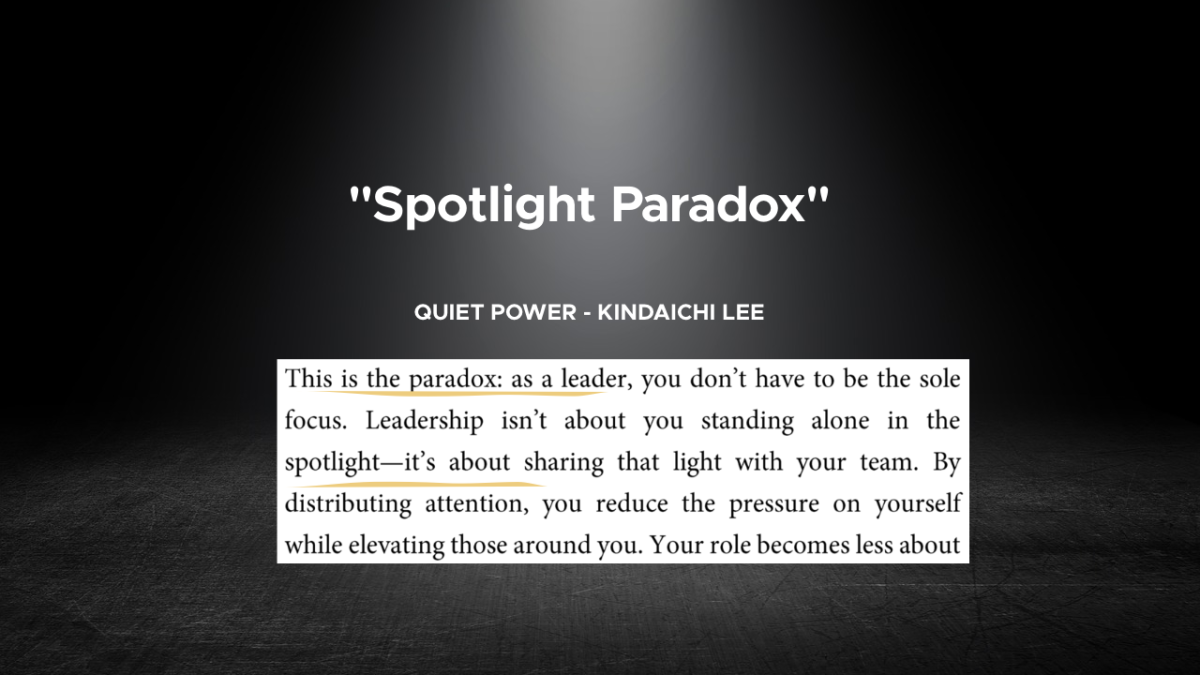
“This is the paradox: as a leader, you don’t have to be the sole focus. Leadership isn’t about you standing alone in the spotlight—it’s about sharing that light with your team. By distributing attention, you reduce the pressure on yourself while elevating those around you.”
Today, we are going to explore how shifting the light off yourself doesn’t make you invisible—it makes you powerful.
We will look at the story of a client who was terrified of “all eyes being on him,” and how he cured his anxiety not by becoming a better performer, but by becoming a Lighting Director.
The Atlas Complex: Why We Fear the Light
Why does leadership anxiety happen?
It happens because we have internalised a “Heroic Model” of leadership. We believe that the Leader is the one with all the answers. The Leader is the one who must speak the most. The Leader is the face of the operation.
When you believe this, every meeting feels like a solo performance. You are Atlas, holding up the sky. If you stumble, the world crashes.
For the introverted leader, this is a nightmare. We process internally. We don’t like the glare of immediate scrutiny. So when the spotlight hits us, our cortisol spikes. We freeze. And then the Imposter Syndrome whispers: “See? You don’t belong here. A real leader would love this.”
But here is the truth: The goal of leadership is not to be the smartest person in the room. The goal is to build the smartest room.
The Case Study: The “Reluctant VP”
Let me introduce you to “Julian.”
Julian was a brilliant systems architect. He was quiet, thoughtful, and deeply respected by his engineers. Because of his competence, he was promoted to VP of Engineering.
Suddenly, his world changed. Instead of writing code in quiet solitude, he was expected to present to the Board of Directors every quarter.
The week before his first Board meeting, Julian was a wreck. He wasn’t sleeping. He was over-preparing, memorizing 50 pages of data. He was terrified.
“I’m going to freeze,” he told me. “They are going to ask me a question about the budget or the timeline, and I’m going to blank out, and they’ll realise they promoted a geek instead of a leader.”
He was suffering from Spotlight Toxicity. He felt that for that hour, he had to be the sole source of wisdom.
The Shift: Becoming the Lighting Director
I stopped him. “Julian,” I said. “You are approaching this like an actor who has to perform a monologue. But you are not the actor. You are the Director.”
We opened the book to the concept of the Spotlight Paradox.
I gave him a challenge. “For this presentation, your goal is not to prove you are smart. Your goal is to prove your team is smart. I want you to deflect at least 50% of the questions.”
He was confused. “Won’t that look weak? Won’t it look like I don’t know the answers?”
“No,” I said. “It will look like you are a leader who trusts his people. It will look like Quiet Power.”
We devised a “Distribution Strategy.” Julian brought two of his key managers with him to the meeting—Sarah (his lead developer) and Ben (his project manager).
The Board Meeting: The Pivot
The meeting began. The spotlight hit Julian. The CEO asked the first hard question: “Julian, why is the migration taking so long? Are we going to miss the Q3 launch?”
The old Julian would have started sweating and tried to explain the technical nuances of the API integration himself, likely stumbling over his words.
The new Julian took a breath (The Pause). He looked at the CEO and said with total calm:
“That is the critical question. The migration is complex, but we have a handle on it. I’ve asked Sarah, who is architecting the API bridge, to join us. Sarah, can you walk the Board through the specific hurdle we cleared last week?”
He physically turned his body toward Sarah. He moved the spotlight.
Sarah, who loved talking about the code, lit up. She gave a brilliant, detailed, 2-minute answer. The Board nodded, impressed by her detail.
Later, the CFO asked about the budget.
Julian didn’t fumble for the spreadsheet. He said, “We are tracking closely to the variance. Ben has been managing the vendor spend. Ben, give them the breakdown on the server costs.”
Ben took the spotlight. Julian sat back, observing, nodding, and adding only the final strategic summary at the end.
The Result: The Paradox in Action
After the meeting, the CEO pulled Julian aside.
Julian braced himself. Here it comes, he thought. He’s going to say I didn’t say enough.
The CEO smiled. “Julian, that was the best update we’ve had in years. You have clearly built an incredible bench of talent. I feel very confident knowing you have people like Sarah and Ben running the details. Great leadership.”
Do you see the paradox?
- By speaking less, Julian was heard more.
- By doing less of the talking, he was given more credit for the leadership.
- By moving the spotlight off himself, his anxiety vanished, and his Authority skyrocketed.
He stopped feeling like an Imposter because he wasn’t trying to be a “Solo Hero” anymore. He was comfortable being the Curator of Talent.
How to Apply the “Spotlight Paradox” (Your Strategy)
If you are suffering from Imposter Syndrome or performance anxiety, try these three shifts this week.
1. The “Pass the Ball” Technique
Before any high-stakes meeting, identify the experts on your team. Tell them in advance: “I might call on you to speak about X.”
When the question comes, don’t hoard it.
- The Script: “That’s a great question. I want you to hear directly from the person leading that initiative. [Name], walk us through that.”
2. The “We” Audit
Review your emails and your scripts. Count the number of times you say “I” versus “We.”
The insecure leader says “I” because they are desperate to prove their value.
The confident Quiet Leader says “We” because their value is self-evident.
- Shift: Instead of “I delivered the project,” say “The team delivered the project, specifically thanks to [Name]’s work on…”
3. The Shine Theory
Make it your specific goal to make someone else look good in every meeting. When you enter a room with the intention of elevating others, your brain switches from “Fear Mode” (Self-Protection) to “Service Mode” (Team-Protection). You physically cannot be stuck in social anxiety when you are focused on helping someone else shine.
The Ultimate Relief
The Spotlight Paradox is the ultimate cure for the introverted leader’s fatigue.
You do not have to carry the world. You do not have to be the smartest person in the room. You do not have to be the most charismatic.
You just have to be the one who holds the flashlight, and points it at the brilliance around you.
As I wrote in the book: “True power isn’t about being the source of the light. It’s about being the mirror that reflects it.”
Until next week, share the light.
Kindaichi Lee, Your Transformative Storyteller 🎬