
The Wired Soul: The Myth of the Scale and the Neuroscience of Flow
(EI & Relationship Mastery Newsletter – Season 6, Article 6)
Good evening from Kuala Lumpur. It has been a busy day and finally able to settle down and pen this.
If you walk into any corporate seminar or open any HR manual, you will inevitably encounter the holy grail of modern professional life: Work-Life Balance.
We talk about it endlessly. We attend workshops on it. We feel a profound, daily guilt for failing to achieve it.
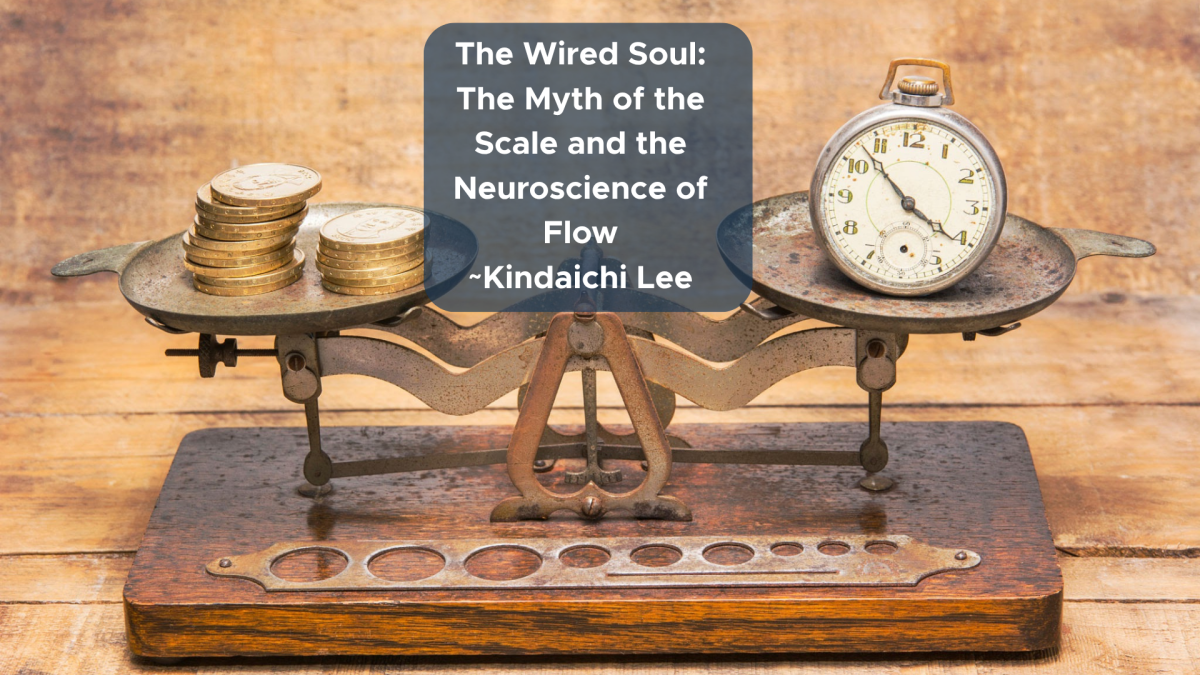
The entire concept is built on a very specific metaphor: The Scale.
We are taught to visualise a brass scale. On one side is “Work.” On the other side is “Life.” The goal of a successful adult is to keep the scale perfectly level.
But this metaphor is fundamentally broken. It implies a zero-sum game. It tells your brain that “Work” is inherently bad—a penalty you pay, a heavy weight that drags you down—and “Life” is the reward you earn for enduring it. If you add to one side, you automatically steal from the other.
Welcome to Week 6 of Season 6: The Wired Soul.
As we continue decoding exhausting leadership clichés using Ikigai as our Compass and Neuroscience as our Engine, we are taking an axe to the concept of the scale. Today, we look at why striving for “balance” is keeping you stuck, and we explore the actual brain science behind what happens when you stop balancing and start flowing.
The Compass (Ikigai): Integration over Opposition
In my practice as a Family Counsellor, I see the damage the “scale” metaphor inflicts on households. Parents come home exhausted, clock out of “Work,” and try to force themselves to clock into “Life.” They compartmentalise. They build high walls between who they are at a desk and who they are at the dinner table.
But humans do not compartmentalise well. The stress from the left side of the scale always bleeds onto the right.
Let’s look at the compass. In the philosophy of Ikigai, the goal is not to balance opposing forces. The goal is Integration.
When you hit the exact center of your Ikigai—the intersection of what you love, what you are good at, what the world needs, and what you are paid for—the scale disappears entirely. Work and Life are no longer in opposition. They are expressions of the same continuous purpose.
When you write a beautiful piece of code, when you mentor a junior team member, or when you deliver a transformative story, you are not “taking away” from your life. You are living it.
You don’t need a scale when the weights are made of the same material.
The Engine (Neuroscience): Transient Hypofrontality
If the goal isn’t to balance a scale, what is the biological target?
You know the feeling. You sit down to work on a project that requires your deep expertise. You get locked in. The office noise fades away. The anxiety about your inbox disappears. You look up at the clock, and three hours have passed in what felt like twenty minutes. You feel exhausted, but it is a clean, deeply satisfying exhaustion.
We casually call this “The Flow State.”
But let’s look at the engine. What is actually happening in your brain during those three hours?
Neuroscientists call this state Transient Hypofrontality.
Let’s break the word down:
- Transient: Temporary.
- Hypo: Less active (the opposite of hyper).
- Frontality: The prefrontal cortex.
Your prefrontal cortex is the executive control center of your brain. It is responsible for logical decision-making, complex planning, and, most importantly, your sense of self and time. It is where your inner critic lives. It is the part of your brain that constantly worries, “Am I doing this right? What will the client think? Did I spend too much time on work today?”
When you enter the flow state, your brain actually powers down the prefrontal cortex.
It trades conscious, over-analytical thinking for rapid, subconscious processing. Because the part of your brain that tracks time is temporarily deactivated, you experience time dilation (hours feel like minutes). Because the part of your brain that generates self-doubt is shut off, your inner critic is silenced.
You are not balancing. You are fully immersed.
The Introvert Advantage: Wired for Flow
Here is the brilliant news for quiet leaders: Introverts are biologically optimised for Transient Hypofrontality.
To achieve this state, the brain requires two things:
- Deep Focus: The elimination of external, shallow distractions.
- High Challenge-to-Skill Ratio: The task must be hard enough to demand your full attention, but not so hard that it induces panic.
Extrovert-heavy corporate cultures run on constant interruptions, loud open-plan offices, and frantic multitasking. This environment guarantees that the prefrontal cortex stays hyper-active and stressed. Flow is impossible.
As a Map Maker and a deep-thinker, your natural preference for solitary work, single-tasking, and deep reflection is the exact biological recipe required to trigger Transient Hypofrontality.
When you operate in your quiet strength, you access a metabolic efficiency that loud, frantic multitasking can never touch.
How to Hack the Flow State This Week
You cannot force Transient Hypofrontality on command, but you can curate the exact conditions required for it to appear.
Here is your application strategy to stop balancing the scale and start triggering the flow state this week:
1. The 90-Minute Fortress
Flow takes approximately 15 to 20 minutes of sustained attention to initiate. Every time your phone buzzes or an email pings, that timer resets to zero.
Identify your most crucial Ikigai-aligned task this week. Block exactly 90 minutes on your calendar. Turn your phone completely off. Shut down your email client. Build a fortress around your attention.
2. The “Goldilocks” Challenge
If a task is too easy, your brain gets bored and your prefrontal cortex starts daydreaming. If it is too hard, your amygdala panics.
Look at the task in your 90-minute block. Adjust the difficulty until it is just right. If you are writing a report you’ve written a hundred times, challenge yourself to write it in half the time or using a new, transformative storytelling framework. Increase the friction just enough to demand your full cognitive engagement.
3. The Transition Ritual
Because work and life are integrated, you need biological signals to tell your brain when to shift gears. You do not need a scale, but you do need a door.
Create a 5-minute transition ritual at the end of your workday. Close all your browser tabs. Write down three priorities for tomorrow. Take three deep, anchoring breaths. This signals to your nervous system that the deep-work phase is over, and the connection-phase (family, rest) is beginning.
Burn the Scale
It is time to stop feeling guilty for failing to balance an impossible equation.
In Quiet Power: Leading with Impact, I wrote about the necessity of shedding the rules that were never built for us in the first place. The Work-Life scale is one of those rules.
Stop trying to weigh your life.
Find the work that silences your inner critic. Find the deep, meaningful tasks that make time disappear. Step into the center of your compass, and let the brain do what it was built to do.
Until next week, keep flowing.