
The Wired Soul: The Bouncer in Your Brain (Programming Your Vision)
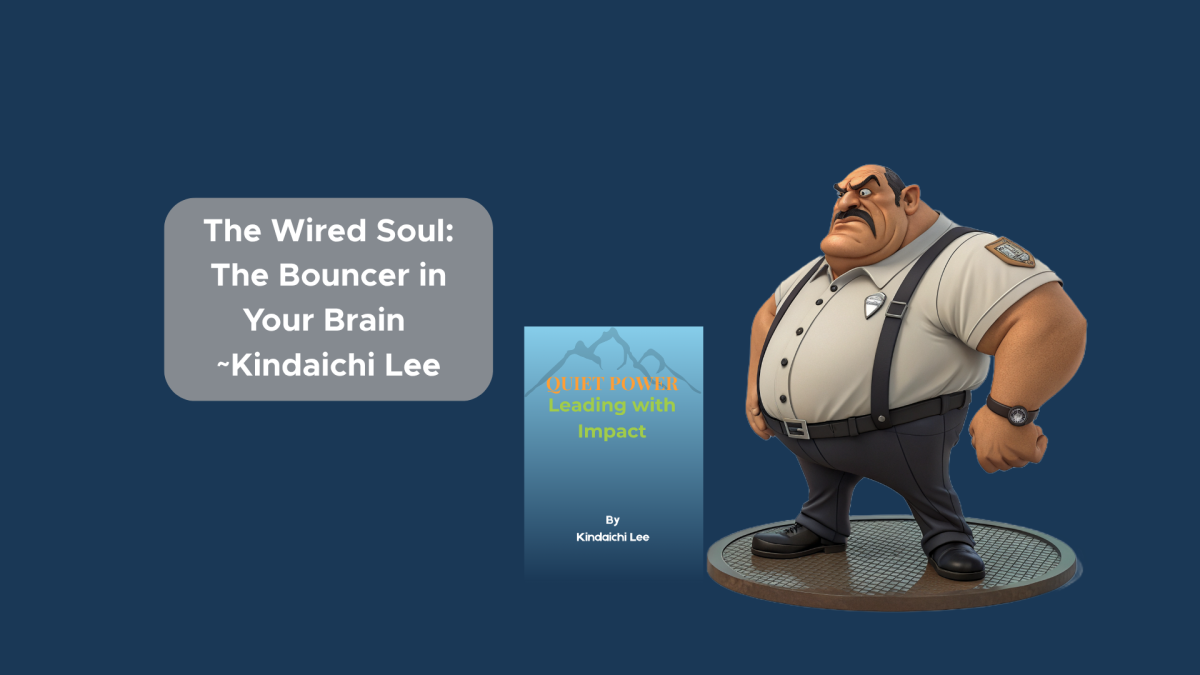
(EI & Relationship Mastery Newsletter – Season 6, Article 7)
Good morning.
If you have ever worked in a corporate office, you know exactly what I am talking about.
Somewhere in the hallway, usually near the water cooler or the main conference room, there is a framed poster. It usually features an eagle soaring over a mountain, or a crew team rowing perfectly in sync at sunrise. At the bottom, in bold capital letters, it says something like: VISION: To be the premier provider of synergistic solutions in our industry.
Nobody reads it. Nobody cares about it. If you asked the employees what the company’s vision was, 90% of them would stare blankly at you.
We treat “Vision” like a corporate decoration. It is a cliché. We write it on a whiteboard during an annual retreat, put it in a PowerPoint deck, and then immediately go back to checking our emails.
Welcome to Week 7 of Season 6: The Wired Soul.
For the past month and a half, we have been using Ikigai as our Compass and Neuroscience as our Engine to decode exhausting leadership clichés. Today, we are taking on “Vision.”
We are going to look at why a vision statement that only focuses on revenue is biologically useless to you. More importantly, we are going to look under the hood of your brain at a bundle of nerves that acts as a bouncer at the door of your consciousness.
When you learn how to program this bouncer, opportunities that were completely invisible to you will suddenly appear right in front of your face.
The Cliché: The Empty Revenue Target
As a Mindset Coach, I often ask entrepreneurs and leaders: “What is your vision for this year?”
The answer is almost always a number. “I want to hit $1 million in revenue,”or “I want to acquire 50 new clients.”
That is not a vision. That is a math equation.
Math is important, but math does not get you out of bed on a Tuesday morning when a client yells at you, your server crashes, and you are running on four hours of sleep. Math does not inspire your team to dig deep when the project goes sideways.
If your vision is purely self-serving—if it stops at the boundaries of your own bank account—it lacks the magnetic pull required to keep you moving through resistance.
The Compass (Ikigai): “What the World Needs”
Let’s look at the Ikigai compass.
True vision lives in the circle labeled: “What the world needs.”
It asks a fundamental, outward-facing question: How is the world—or your specific corner of it—better because your business exists?
When I wrote my first book, DISCerning Parenting, my vision wasn’t “sell X amount of copies.” My vision was to stop parents from fighting with their children out of misunderstanding, and to give them the tools to raise successful, emotionally intelligent kids.
That is a vision. It is anchored in service. It goes beyond just making money.
When your vision is anchored in “What the world needs,” you stop being a salesperson peddling a product, and you become a leader offering a lifeline. People don’t follow spreadsheets. They follow leaders who see a better future and know how to get there.
The Engine (Neuroscience): The Reticular Activating System (RAS)
Now, let’s look at the biology. Why does having a clear, service-oriented vision actually change your physical reality?
Right now, as you read this email, millions of bits of sensory data are bombarding you. The hum of the air conditioner, the feeling of the chair against your back, the notifications on your phone, the colours in your peripheral vision.
If your brain tried to consciously process all of that data, it would instantly short-circuit. You would go mad.
So, evolution gave you a biological filter. It is a network of neurons located in your brainstem called the Reticular Activating System (RAS).
Think of the RAS as the bouncer at the VIP club of your conscious mind. The bouncer’s job is to block 99% of the information from getting in, and only let the important stuff through.
How does the bouncer know what is important? You program it.
You have experienced this before. It’s called the “Red Car Syndrome.” You decide you want to buy a red Honda Civic. Suddenly, everywhere you drive, you see red Honda Civics. Did everyone in your city suddenly buy one overnight? No. They were always there. But before, your RAS was filtering them out as “irrelevant data.” The moment you set an intention, you gave the bouncer a new photo, and said: “Let this through.”
When a leader says, “I can’t find any good clients,” or “There are no opportunities right now,” it is rarely the truth. The truth is that their RAS is programmed to spot obstacles, stress, and scarcity.
When you clarify your Ikigai—when you define exactly who you want to serve and what the world needs—you are literally writing code for your RAS.
Once the bouncer has the code, you will start walking into networking events, reading articles, or having casual conversations, and your brain will flag resources, partnerships, and opportunities that were completely invisible to you the day before.
They were always there. You just finally told your brain to let them in.
How to Program the Bouncer This Week
A vision board is nice, but physical action is what programs the RAS. Here is how you write the code this week:
1. The “Who” and “What” Command
Your RAS needs specificity. “I want to grow my business” is too vague. The bouncer doesn’t know what to look for.
Write down one specific sentence that defines your Ikigai-driven vision for this quarter.
Example: “I am looking for mid-sized tech companies whose introverted leaders are struggling with burnout, so I can teach them how to build quiet authority.”
Read that out loud before you start your workday. You are giving the bouncer the VIP list.
2. Focus on the Process, Not Just the Poster
Don’t just visualise the end goal (standing on a stage, depositing a check). Visualise the actions you need to take to get there. When you visualise yourself having a difficult conversation with a client, or spending two hours writing a proposal, you prime your nervous system to execute those tasks with less friction when they actually happen.
3. Put Yourself in Experiential Environments
The RAS loves new, dynamic environments to scan for opportunities. You cannot program it by sitting in the same home office staring at the same wall every day. You have to break the pattern.
Let’s continue breaking the pattern, keep your vision clear and let the bouncer do its job….