
The Wired Soul: Stop Building Empires and Start Building Ecosystems (The Neuroscience of Legacy)
(EI & Relationship Mastery Newsletter – Season 6, Article 10 – SERIES FINALE)
Good morning from Kuala Lumpur.
Grab a coffee. Take a deep breath. We made it to the end of Season 6.
For the past ten weeks, we have been taking a sledgehammer to the most exhausting, extrovert-heavy clichés in modern leadership. We’ve used Ikigai as our compass and Neuroscience as our engine to rewire how we think about passion, burnout, empathy, and vision.
Today, we are tackling the final boss. The cliché that hangs over every founder, manager, and parent as they get older: Leaving a Legacy.
When you hear the word “legacy,” what is the first image that flashes into your mind?
For most of us, it’s a monument. We picture a billionaire tech founder stepping off a private jet. We picture a towering corporate headquarters with a family name plastered on the side. We picture viral fame, millions of followers, and an empire that spans the globe.
Here is the truth: For the introverted, deeply empathetic leader, the idea of building a loud, massive “empire” doesn’t sound inspiring. It sounds exhausting.
If your definition of legacy is tied to how much noise you make or how much real estate you conquer, you will spend your entire life feeling like you are falling short.
Today, in our series finale, we are going to redefine legacy for the quiet leader. We are going to look at why true legacy isn’t about the company you leave behind, but the nervous systems you stabilize along the way.
The Compass (Ikigai): Legacy is Alignment, Not Ego
In my practice as a Family Counsellor, I have sat with people at the end of their careers. Not a single one of them has ever looked back and said, “I wish I had captured 4% more market share.”
When the noise fades, they evaluate their lives based on alignment. Did they matter to the people sitting around their dinner table? Did their work mean something?
Let’s look at the center of your Ikigai.
When you find that perfect overlap—doing what you love, what you are highly skilled at, what the world desperately needs, and what sustains you financially—you stop trying to build a monument to your own ego.
True legacy is not what you leave behind for people. It is what you leave inside them.
It is the junior copywriter who learned how to trust her own voice because you gave her the space to speak. It is the ops manager who stopped having panic attacks before board meetings because your calm presence taught him that failure isn’t fatal. It is your own children (a core philosophy from DISCerning Parenting) who grow up feeling securely attached because they watched you navigate stress with quiet resilience.
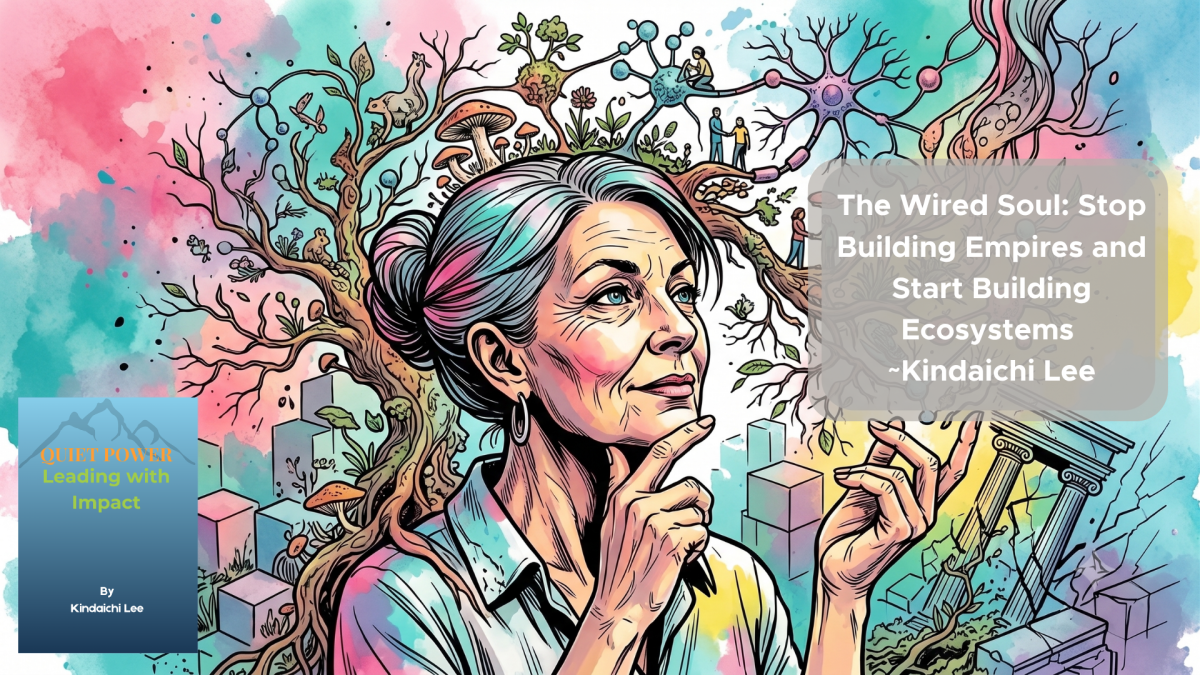
Your Ikigai doesn’t build empires. It builds ecosystems. And ecosystems outlive empires every single time.
The Engine (Neuroscience): The Oxytocin Loop
If legacy is about what we leave inside people, how does that actually work on a biological level?
In previous weeks, we talked about Mirror Neurons—how your brain physically simulates the emotions of the people around you. When an extroverted “Gladiator” leader walks into a room and starts shouting about missed deadlines, they trigger a mass release of cortisol (the stress hormone) in the nervous systems of everyone present. They create a culture of survival.
But what happens when you lead with Quiet Power?
What happens when a crisis hits, the servers crash, the client threatens to walk, and instead of yelling, you drop into your “Still-Point”? You lower your voice. You ask a clarifying question. You listen at Level 3.
Because of those same Mirror Neurons, your grounded, regulated nervous system acts as an anchor for the entire room. When your team subconsciously realises that you are not going to attack them, their amygdala power down.
And then, the magic happens. Their brains release Oxytocin.
We often call oxytocin the “cuddle hormone,” but in leadership, it is the neuro-chemical of trust, psychological safety, and human bonding. When a team operates in a high-oxytocin environment, they take creative risks. They cover for each other’s weaknesses. They innovate without fear.
Here is the most beautiful part of the neuroscience: Oxytocin creates a biological loop.
When you lead with quiet, empathetic authority, you trigger oxytocin in your team. That trust makes them more collaborative and supportive, which in turn triggers an oxytocin release in you. You physically change the structural culture of the team at a neuro-chemical level.
Long after you retire, leave the company, or move on to your next adventure, that biological blueprint remains. The junior leaders you mentored will face their own crises, and because you wired their brains for psychological safety, they will drop into their own Still-Points.
They will lead their teams with the quiet power they borrowed from you.
That is how you leave a legacy. Not by carving your name in stone, but by permanently altering the neurobiology of the people you lead.
Introducing: The Experiential Lab
As a Storytelling & Transformative Trainer, I know that reading about a concept isn’t enough to change your life. You have to put it in your body.
Moving forward into our next season, every newsletter will end with The Experiential Lab—a 5-minute somatic, reflective, or NLP-based activity you can do right at your desk to anchor the lesson.
This Week’s Lab: The Legacy Audit
- Close your eyes and take one deep, anchoring breath.
- Think back over the last 7 days. Identify one person whose nervous system you stabilized.
- Write their name on a sticky note and put it on the bottom corner of your monitor today.
- Look at that name. You didn’t build a monument this week, but you changed the neurochemistry of a human being. That is your legacy in action.
What’s Next? (Welcome to Season 7)
This concludes Season 6. We have rewired the engine.
But as we look to the future, I realised something. As a Mindset Coach, I can give you all the tools in the world to handle external conflict and biological stress. But if the story you tell yourself about who you are is broken, none of it matters.
Next week, we are launching an entirely new era.
Welcome to Season 7: The Narrative Architect.
We are going to dive deep into internal narrative architecture and neuro-linguistic programming (NLP). We are going to explore how to recode the stories you tell yourself about your quietness, your imposter syndrome, and your authority. Before we can change the culture, we have to rewrite the protagonist.
You hold the pen. Get ready to edit the script.
Until next week, keep your compass true and your engine steady.