
From the Pages: Authenticity vs. The Extrovert Ideal (The Exhaustion of the Mask)
(EI & Relationship Mastery Newsletter – Season 4, Article 8)
Good evening.
Welcome back to Season 4 of “EI & Relationship Mastery.”
We have spent the last few weeks dissecting specific tools—Silence, Empathy, Pruning. These are the tactics of Quiet Power.
But today, we need to talk about the strategy. And more importantly, the cost of getting that strategy wrong.
In Western business culture (and increasingly in global corporate culture), there is a pervasive myth. It is the myth of the “Extrovert Ideal.” It tells us that the ideal leader is gregarious, alpha, constantly visible, and effortlessly charismatic. It tells us that if you want to lead, you must act like that.
For the introvert, this creates a terrible pressure. We feel we must “put on a show.” We treat our personality like a costume that we must zip up every morning before we walk into the office.
But costumes are heavy. And masks are suffocating.
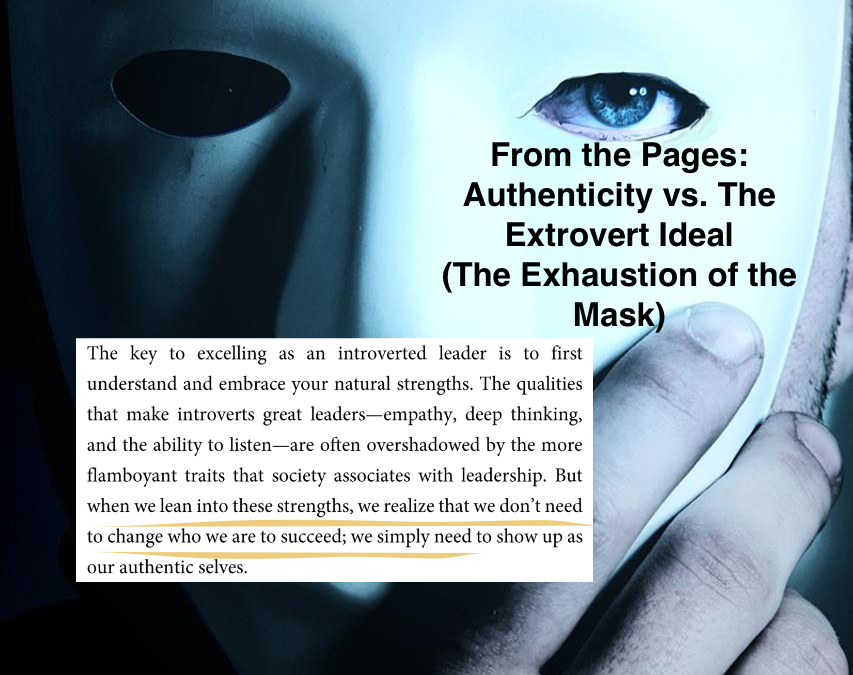
In Chapter 2 of my book, “Quiet Power: Leading with Impact,” I address this head-on. I wrote:
“The key to excelling as an introverted leader is to first understand and embrace your natural strengths… But when we lean into these strengths, we realize that we don’t need to change who we are to succeed; we simply need to show up as our authentic selves.”
Today, we are going to explore the high price of the “Acting Tax.”
I want to share the story of a client who nearly destroyed his career by trying to mimic a loud, charismatic predecessor, and how he only found success when he finally dared to stop acting and start leading as himself.
The Biological Cost of the Mask
Why is “faking it” so dangerous?
We often hear advice like “Fake it ’til you make it.” In small doses—like forcing a smile to get through a tough morning—this is fine. But as a long-term leadership strategy, it is a disaster.
When an introvert forces themselves to act like an extrovert for 8, 10, or 12 hours a day, they are engaging in what psychologists call “Surface Acting.”
This is not just a mood killer; it is a cognitive drain.
- The Cognitive Load: Your brain is splitting its resources. 40% of your processing power is monitoring your performance (“Am I smiling enough? Am I loud enough?”), leaving only 60% for the actual work of strategy and decision-making.
- The Dissonance: When your external behaviour conflicts with your internal state, it creates cortisol (stress). You are essentially keeping your body in a low-level “Fight or Flight” state all day.
This is the “Exhaustion of the Mask.” You aren’t tired because the work is hard. You are tired because the acting is hard.
And the worst part? The audience knows. Humans are evolutionary lie detectors. When a leader is masking, the team senses a micro-disconnect. They don’t see “charisma”; they see “inauthenticity.” And you cannot build trust on a fake foundation.
The Case Study: The Shadow of the Giant
Let me introduce you to “Marcus” (name changed).
Marcus was a brilliant COO. He was the classic Deep Diver—analytical, quiet, steady, and deeply respected for his operational mind. He worked for a CEO we’ll call “Big Tom.”
Big Tom was a legend. He was 6’3″, had a booming voice, slapped people on the back, and could rally the company with a 5-minute speech that had people ready to run through walls. He was the ultimate Gladiolus.
When Big Tom retired, the Board promoted Marcus to CEO.
Marcus was terrified. He looked at Big Tom’s legacy and thought, “That is what a CEO looks like. I need to be Big Tom.”
The “Mini-Tom” Disaster
Marcus started his tenure by putting on the mask.
- He tried to do the “Monday Morning Pep Rallies” that Tom did. But instead of booming, Marcus sounded forced and awkward. The jokes fell flat.
- He tried to be “everywhere.” He walked the floor, interrupting people to “check in,” even though he hated small talk and so did his engineers.
- He stopped doing his deep reading time because he thought it looked “passive.”
Three months in, the company was drifting.
The engagement surveys came back brutal. The comments were stinging: “Marcus feels fake.” “I don’t know who he is anymore.” “He’s trying too hard.”
Marcus came to me on the verge of resignation. He was physically sick from stress.
“I can’t do it,” he said, head in his hands. “I can’t be him. I don’t have his energy. I’m failing.”
“You are failing,” I agreed gently. “But not because you aren’t Tom. You are failing because you aren’t Marcus.”
I opened the book to the quote we started with today.
“Marcus,” I said. “The Board didn’t hire Tom’s ghost. They hired you. They hired the man who fixed the supply chain. They hired the man who thinks in decades, not quarters. Why are you depriving them of the asset they bought?”
The Pivot: Dropping the Act
We designed a “Re-Authentication Strategy.” It was terrifying for him, but necessary.
Step 1: The Confession (Vulnerability)
Marcus called an All-Hands meeting. No music. No hype. He sat on a stool.
“I’ve been trying to be Tom for the last 90 days,” he told the company. “And I think we can all agree, I’m a terrible Tom.”
A ripple of laughter went through the room. The tension broke.
“Tom was a great cheerleader,” Marcus continued. “I am not a cheerleader. I am an architect. I don’t lead by shouting. I lead by building. And starting today, I’m going to lead my way.”
Step 2: The Ritual Swap
He cancelled the “Monday Pep Rallies.” The extroverts groaned, but Marcus replaced them with “Friday Fireside Chats.”
These were Q&A sessions where Marcus answered the hardest, most technical questions from the staff with total transparency. No hype. Just deep, honest clarity.
Step 3: The Deep Work Signal
He stopped the aimless “walking the floor.” He put a sign on his door from 8 AM to 11 AM: “Deep Work / Strategy Time.”
This signalled to the company that thinking was real work.
The Result: The Resonance of Truth
The shift was palpable.
- Trust Returned: When Marcus stopped acting, his “micro-expressions” aligned with his words. He became readable. The team relaxed because they knew who he was.
- Performance Spiked: Marcus wasn’t wasting 40% of his energy on acting. He poured that energy into a new strategic roadmap that saved the company $10M in waste.
- The “Quiet” Culture: The introverts in the company (about 50% of the staff) suddenly felt validated. They realized they didn’t have to be “Mini-Toms” to succeed either.
Marcus didn’t succeed despite being quiet. He succeeded because he embraced his quiet nature. He moved from being a “Second-Rate Extrovert” to a “First-Rate Introvert.”
How to Take Off Your Mask (Your Application)
If you feel the exhaustion of the mask, here is your strategy for this week.
1. The “Acting Audit”
Identify the one ritual or behaviour you do solely because you think “that’s what a leader does,” even though it drains you.
- Is it the “networking lunch” every day?
- Is it the “fake enthusiasm” in emails (using !!! when you feel .)?
- Is it the “brainstorming shout-fest”?
2. The Authentic Swap
Don’t just stop doing it; replace it with a version that fits your strengths.
- Hate Networking Lunches? Swap them for one-on-one coffees or a thoughtful email check-in.
- Hate Shout-Fests? Implement a “Silent Read” at the start of meetings where people write ideas down first (The Amazon model).
3. The “User Manual” Declaration
Tell your team how you work.
- Say: “I want to give you my best leadership. To do that, I need to process things internally before I speak. So if I’m quiet in a meeting, I’m not disengaged; I’m thinking. I will give you my decision by email afterward.”
The Paradox of Influence
Here is the final truth.
The world is full of noise. We are bombarded by “performers” on social media, in politics, and in business.
Because of this, Authenticity has become the rarest and most valuable commodity.
When a leader has the courage to stand in their own skin—quietly, calmly, without apology—it is magnetic. It signals a security that noise can never fake.
As I wrote in the book:
“We don’t need to change who we are to succeed; we simply need to show up as our authentic selves.”
Stop trying to be the leader you think you should be.
Be the leader you are.
Until next week, drop the mask.
Kindaichi Lee, Your Transformative Storyteller 🎬