
From the Pages: The Definition of Quiet Authority
(EI & Relationship Mastery – Season 4, Article 1)
Good morning from Kuala Lumpur.
Welcome to a brand new season of “EI & Relationship Mastery.”
For the past 30 weeks, we have been on a journey together—from the basics of emotional intelligence to the deep mechanics of introverted leadership. We have explored the theory, the mindset, and the “why.”
Now, with my book “Quiet Power: Leading with Impact” officially out in the world, we are shifting gears. We are moving from exploration to application.
In this new season, titled “From the Pages,” each week I will pull a specific concept, a key quote, or a critical framework directly from the book. We will take that idea off the page and put it to work. We will dissect it through real-world client stories, practical exercises, and deep-dive analysis.
We start today at the very beginning. We start with the definition.
In Chapter 1 of Quiet Power, I wrote a sentence that has become a mantra for many of my clients. It challenges the oldest, most persistent myth in the corporate world:
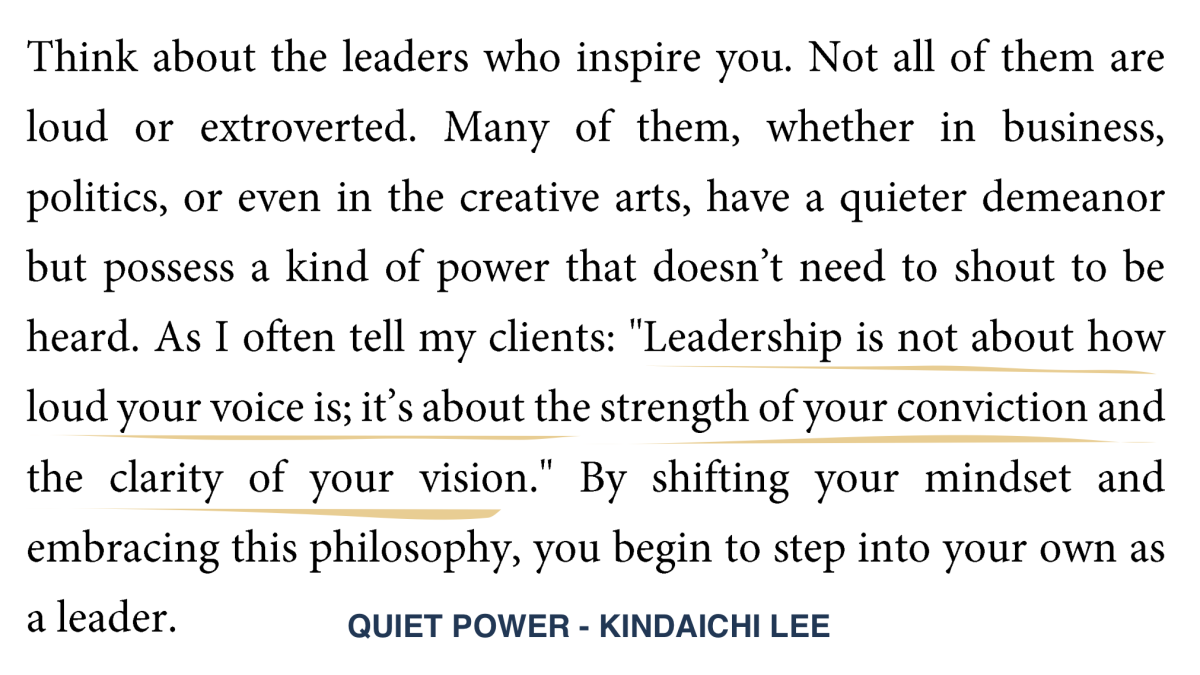
“Leadership is not about how loud your voice is; it’s about the strength of your conviction and the clarity of your vision.”
This week, we explore what that actually looks like in practice. We are going to deconstruct the myth of the “Loud Leader” and tell the story of a client who stopped trying to shout and started learning to see.
The Decibel Fallacy: Why We Confuse Volume with Value
Walk into almost any boardroom, and you will witness a strange phenomenon. I call it the Decibel Fallacy.
We have a cognitive bias that equates confidence with competence. When someone speaks quickly, loudly, and without hesitation, our “System 1” brain (our fast, intuitive thinking) tags them as a “Leader.” We assume that because they are taking up space, they must know where they are going.
Conversely, when someone pauses, speaks softly, or admits uncertainty, our bias tags them as “Submissive” or “Unsure.”
This bias is dangerous. It leads organisations to promote the Performers—the ones who are good at acting like leaders—while overlooking the Architects—the ones who are actually good at building the future.
The Performer leads with Noise.
The Architect leads with Conviction.
Noise is external. It requires constant energy to maintain. It fades the moment the person leaves the room.
Conviction is internal. It is a deep, resonant frequency. It is the unshakeable belief in a path forward, grounded in evidence and values. It doesn’t need to shout because it is solid.
The Case Study: The “Invisible” Strategist
To understand this shift, let me tell you about a client named Elena (name changed for privacy).
Elena was a Director of Operations at a large logistics firm. She was brilliant. She had an almost supernatural ability to spot inefficiencies in complex supply chains. She was also deeply introverted.
In meetings, Elena was a Deep Diver. While her colleagues were “thinking out loud,” throwing half-baked ideas against the wall to see what stuck, Elena was silent. She was processing. She was simulating the outcomes. She was finding the flaws.
But by the time she had formulated her thought, the conversation had moved on. The “Loud Leaders” had already dominated the airtime.
Her performance reviews were glowing about her technical skills, but they all contained the same “feedback” in the leadership section:
- “Elena needs more executive presence.”
- “She needs to speak up more in meetings.”
- “She is too quiet to lead the division.”
She was passed over for a VP promotion twice. The role went to a charismatic “Action Hero” who gave great speeches but kept missing his operational targets.
Elena came to me defeated. “I can’t do it,” she said. “I can’t be like him. I can’t interrupt people. I can’t fake that high-energy bravado. If that’s what leadership is, then maybe I’m not a leader.”
I opened my notebook and wrote down the quote we started with today.
“Elena,” I said, “You are trying to compete on volume. You will always lose that game. We need to change the battlefield. We are going to compete on Clarity.”
The Pivot: From Posturing to Conviction
We stopped trying to “fix” Elena’s personality. We stopped the “assertiveness training.” Instead, we leaned into her Quiet Power.
The company was facing a major crisis: their shipping costs were skyrocketing, and the “Loud Leaders” were panicking. They were holding frantic brainstorming sessions, suggesting random cost cuts, firing vendors, and creating chaos.
Elena didn’t join the noise. She went to her Still-Point.
She spent two weeks doing a deep-dive analysis of the shipping data. She didn’t just look at the costs; she looked at the structure. She found the root cause: a flawed routing algorithm that had been implemented three years ago. It was a complex, boring, un-sexy technical problem that the “Action Heroes” had completely missed because they were too busy putting out fires.
She had the answer. Now, she needed to lead.
In the past, Elena would have tried to bring this up in a meeting, been interrupted, and given up. This time, we used a different strategy. We used the “Written Conviction” approach.
Elena wrote a 6-page white paper. It was titled simply: “The Route to Profitability: A Structural Analysis.”
- It had no fluff.
- It had no “corporate speak.”
- It was pure Clarity. It outlined the problem, the data proving the problem, the solution, and the projected $4 million in savings.
She didn’t email it to the whole group. She printed it out. She walked into the CEO’s office during a quiet time.
“I have a plan to solve the shipping crisis,” she said. Her voice wasn’t loud, but it was steady. She held the document. “I don’t want to brainstorm it. I want you to read this. It contains the solution.”
She placed it on his desk and left.
The Result: The Sound of a Pin Drop
The CEO read it. Then he gave it to the CFO.
Two days later, Elena was called into the executive meeting. The “Action Hero” VP was there, ready to pitch another “big idea.” The CEO held up his hand.
“Stop,” the CEO said. “We’re done guessing. Elena has the map.”
He turned to Elena. “Walk us through the execution.”
For the next 45 minutes, Elena led. She didn’t shout. She didn’t pace around the room. She sat in her chair and spoke with the absolute authority of someone who knows the truth. She answered every question. She parried every objection with data.
The room was silent. Not the silence of boredom, but the silence of respect. The “Loud Leaders” had nothing to say because their noise couldn’t compete with her Clarity.
They implemented her plan. The company saved $4.5 million that year. Six months later, the “Action Hero” was moved to a sales role, and Elena was made VP of Operations.
She didn’t get the job because she learned to be loud. She got the job because she learned that conviction is louder than volume.
How to Build Your “Quiet Authority”
So, how do you apply this? If you are an introvert feeling overlooked, how do you stop competing on noise and start leading with conviction?
1. Stop “Thinking Out Loud”
The “Loud Leader” processes externally. They talk to think. You process internally. Do not try to mimic them. It is okay to be silent in a meeting if you are processing. But—and this is key—you must communicate that process.
- Say: “I am listening to all these points. I want to take the time to integrate them. I will come back to you with a reasoned proposal by tomorrow.”
2. Do the Deep Work First
Conviction comes from competence. You cannot have “Quiet Authority” if you don’t know your stuff. Use your natural ability for deep work (The Deep Diver) to research, analyze, and understand the problem better than anyone else in the room. Your confidence will come from your preparation, not your personality.
3. Use the “Artifact” Strategy
Elena used a white paper. You might use a slide deck, a memo, or a prototype. Introverts often communicate better in writing than in impromptu speech. Create an artifact that speaks for you. A well-written document has a “conviction” that is hard to interrupt.
4. Anchor in “Why”
When you do speak, anchor yourself in the vision. Don’t get drawn into petty arguments. Keep bringing the conversation back to the “North Star.”
- Say: “I hear the concern about the timeline. But if we rush this, we violate our core promise of quality. My conviction is that we must hold the line on quality.”
The Invitation
The world is noisy. It is full of people shouting to be heard.
But if you listen closely, you will notice that the people who are actually changing the world—the scientists, the strategists, the true builders—are often quiet. They are not concerned with being the center of attention. They are concerned with being right.
You have that power. You have the ability to see things others miss. You have the ability to think deeply before you act.
Do not trade that for a megaphone.
Trust your vision. deepen your conviction. And let your clarity do the talking.
This is the lesson from Chapter 1 of “Quiet Power: Leading with Impact.” And it is just the beginning.
Action Step for this Week:
Identify one area where you have been holding back your opinion because you didn’t want to “fight” for airtime.
Don’t fight. Go away, do the deep work, write down your plan with absolute clarity, and present it as a finished thought. See what happens.
Until next week, lead quietly.
Kindaichi Lee, Your Transformative Storyteller 🎬