
From the Pages: The Power of “Strategic Silence”
(EI & Relationship Mastery – Season 4, Article 2)
Good afternoon.
Welcome back to Season 4 of “EI & Relationship Mastery.”
Last week, we dismantled the “Decibel Fallacy”—the misconception that volume equals value. We saw how “Elena” used written clarity to bypass the noise and lead with conviction.
This week, we are going to explore a tool that is even quieter, yet arguably more powerful. It is a tool that most people are terrified of. They treat it like a void, an awkward gap that must be filled immediately with words, jokes, or apologies.
I am talking about Silence.
But not just any silence. Not the silence of timidity or the silence of not knowing the answer. We are talking about Strategic Silence.
In Chapter 9 of my book, “Quiet Power: Leading with Impact,” I explore the mechanics of communication for the introverted leader. There is a paragraph in it that I find myself returning to again and again in my coaching sessions:
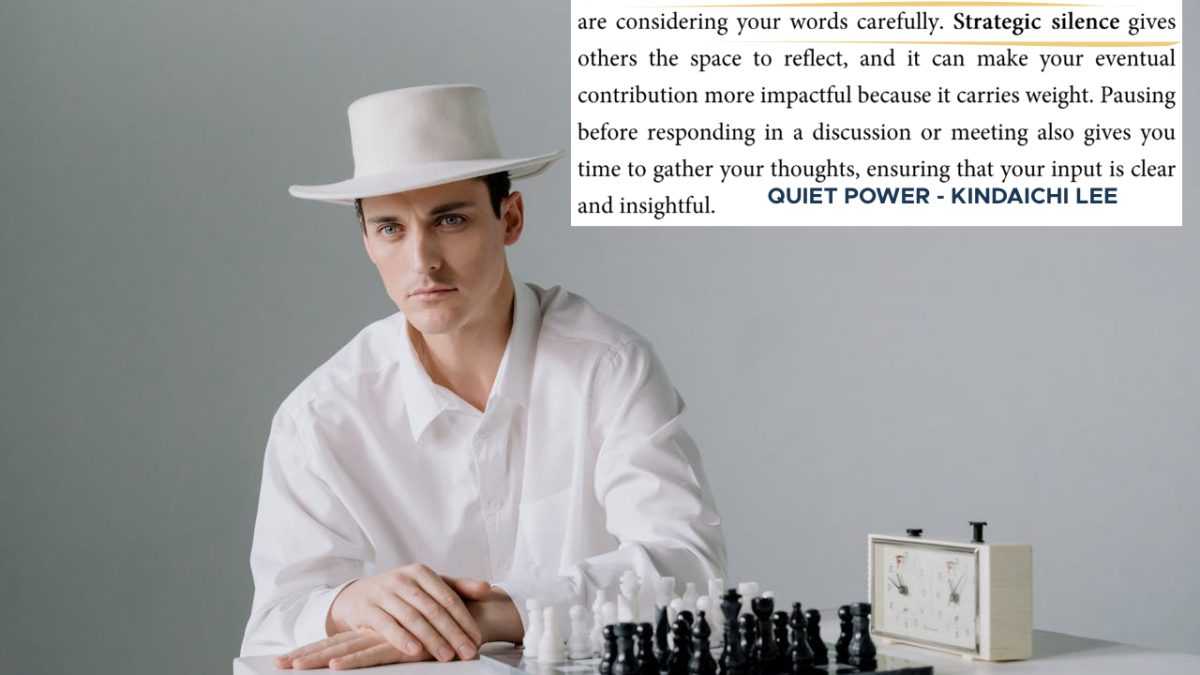
“When you pause before speaking, you communicate that you are considering your words carefully. Strategic silence gives others the space to reflect, and it can make your eventual contribution more impactful because it carries weight.”
Most negotiation books tell you what to say.
Today, we are going to talk about when to stop saying anything at all.
We will explore how one client turned a hostile, high-stakes conflict into a collaborative breakthrough simply by refusing to fill the silence.
The Fear of the Void
Why are we so afraid of silence?
In Western-influenced business culture, silence is often interpreted as a vacuum.
- “If I don’t speak, they’ll think I’m disengaged.”
- “If there’s a pause, the client will think I don’t have a solution.”
- “Silence means something is wrong.”
This fear drives us to babble. We over-explain. We negotiate against ourselves (“The price is $50k… but we can do $45k if that’s too high…”). We interrupt others just to show we are “tracking.”
But for the master communicator—and especially for the introverted leader—silence is not a void. It is a Canvas.
It is the white space that makes the text readable. It is the pause in music that gives the note its rhythm. Without silence, communication is just noise.
Strategic Silence serves three critical functions:
- It Regulates Emotion: It forces the “hot” emotional brain to cool down.
- It Invites Disclosure: Nature abhors a vacuum. If you stay silent, the other person will almost always fill it, often revealing more than they intended.
- It Amplifies Authority: The person who is comfortable in silence is viewed as the person in control.
The Case Study: The Hostile Merger
Let me introduce you to “David” (name changed). David was the CTO of a specialised software firm that was being acquired by a much larger, aggressive conglomerate.
The integration was going poorly. The acquiring company’s VP, a man we’ll call “The Steamroller,” was demanding impossible timelines for the tech migration. He was loud, aggressive, and used to bullying smaller companies into submission.
David was a classic introvert—thoughtful, soft-spoken, and deeply technical. He was terrified of the upcoming “Integration Summit.”
“He’s going to eat me alive,” David told me. “He yells, he interrupts. I can’t out-shout him. I feel like I need to have a perfect rebuttal for everything he says instantly, or he’ll just run over me.”
“David,” I said. “You are trying to play tennis with a boxing champion. Don’t hit the ball back instantly. Catch it. Hold it. Let him wait.”
We practiced Strategic Silence. We scripted his opening, but more importantly, we scripted his pauses.
The Showdown: Holding the Silence
The meeting took place in a glass-walled conference room. The Steamroller started exactly as expected. He launched into a 10-minute tirade about how “unacceptable” the current pace was, how David’s team was “dragging their feet,” and how “heads would roll” if the migration wasn’t done in 30 days (a 6-month job).
He finished his rant, red-faced, and stared at David. “So? What’s your excuse?”
The old David would have immediately jumped in: “Well, actually, it’s not an excuse, the technical debt is…” This would have sounded defensive. It would have been a fight.
The new David did something different.
He did nothing.
He sat perfectly still. He maintained eye contact. He took a slow breath. He looked down at his notebook, seemingly considering the VP’s words.
One second passed.
Two seconds.
Three seconds. (In a high-tension room, three seconds feels like an hour).
Four seconds.
The room was deathly quiet. The Steamroller’s face shifted from angry to confused. Why isn’t he fighting back? Why isn’t he scared?
Finally, after five full seconds, David looked up. He spoke quietly and slowly.
“I hear your frustration regarding the timeline,” David said. “And I understand that the 30-day target is critical for your Q3 goals.”
He paused again. Another three seconds of silence.
“However,” David continued, “physics does not negotiate. If we migrate in 30 days, we will corrupt 40% of the customer data. That is a mathematical certainty.”
He stopped. He didn’t offer a compromise. He didn’t apologize. He just let that “mathematical certainty” hang in the air.
The Steamroller opened his mouth to yell, but stopped. There was nothing to yell at. David hadn’t been rude. He hadn’t been emotional. He had just been… heavy.
“Well,” the VP stammered, his volume dropping by half. “We can’t have data corruption. That’s… obviously not an option. So what can we do?”
The dynamic had flipped. The “Child vs. Parent” dynamic was gone. It was now “Adult vs. Adult.”
David laid out a realistic 4-month plan. Because he had used silence to strip the emotion out of the room, the VP was forced to engage with the logic. They agreed on a 3.5-month timeline.
David won not by shouting, but by refusing to be rushed.
The Mechanics of the “Heavy Pause”
How do you execute this? It feels unnatural at first. Here is the breakdown of the technique David used.
1. The Anchor Breath
When the other person stops speaking, physically force yourself to take one deep inhale and exhale through your nose before you open your mouth. This does two things: it oxygenates your brain (bringing your prefrontal cortex back online) and it creates a mandatory 2-second gap.
2. The Thoughtful Gaze
Don’t look like a deer in headlights. Look like a judge considering a verdict. Look at your notes, look off to the side as if accessing a file in your brain, then look back at them. You are signaling: I am treating your words with serious consideration.
3. The Validation Bridge
When you break the silence, don’t start with “But.” Start with “I hear you.” Validate their emotion. This proves that you were listening during the silence, not just reloading your weapon.
4. The “Period” Drop
When you make your point, put a “period” at the end of it. Stop talking.
- Weak: “We can’t do that because of the budget, you know, things are tight, so maybe we could look at…” (Trailing off).
- Strong: “We cannot do that. The budget does not exist.” (Silence).
Application: Your “Silence” Experiment
This week, I want you to try this in a low-stakes environment first. Maybe with your spouse, your kids, or a colleague.
The Challenge:
In your next conversation, when the other person asks you a question, do not answer immediately.
Count to three in your head. One Mississippi. Two Mississippi. Three Mississippi.
Then answer.
Notice what happens.
Notice the anxiety in your own chest (that’s the “Acting Tax” leaving your body).
Notice how the other person leans in.
Notice how much more authoritative you sound.
“Leadership is not about how loud your voice is; it’s about the strength of your conviction…”
And sometimes, the strongest conviction is the one that doesn’t need to be rushed.
Until next week, embrace the pause.
Kindaichi Lee, Your Transformative Storyteller 🎬