
From the Pages: Protecting Energy as a Strategy (Not Just Self-Care)
(EI & Relationship Mastery Newsletter – Season 4, Article 7)
Good afternoon.
Welcome back to Season 4 of “EI & Relationship Mastery.”
We have a problem with how we talk about “Self-Care.”
If you search that term online, you will see images of bubble baths, scented candles, and people meditating on mountaintops. We have been conditioned to view self-care as a luxury—something you do after the work is done. It is treated as a reward for burnout, or a “soft” activity for people who can’t handle the heat.
In the high-stakes world of business, this framing is dangerous. It suggests that protecting your energy is separate from your performance.
I want to flip that script today.
In Chapter 8 of my book, “Quiet Power: Leading with Impact,” I explore the concept of sustainable leadership. I move away from the “Action Hero” model (who never sleeps) to the “Gardener” model.
I wrote:
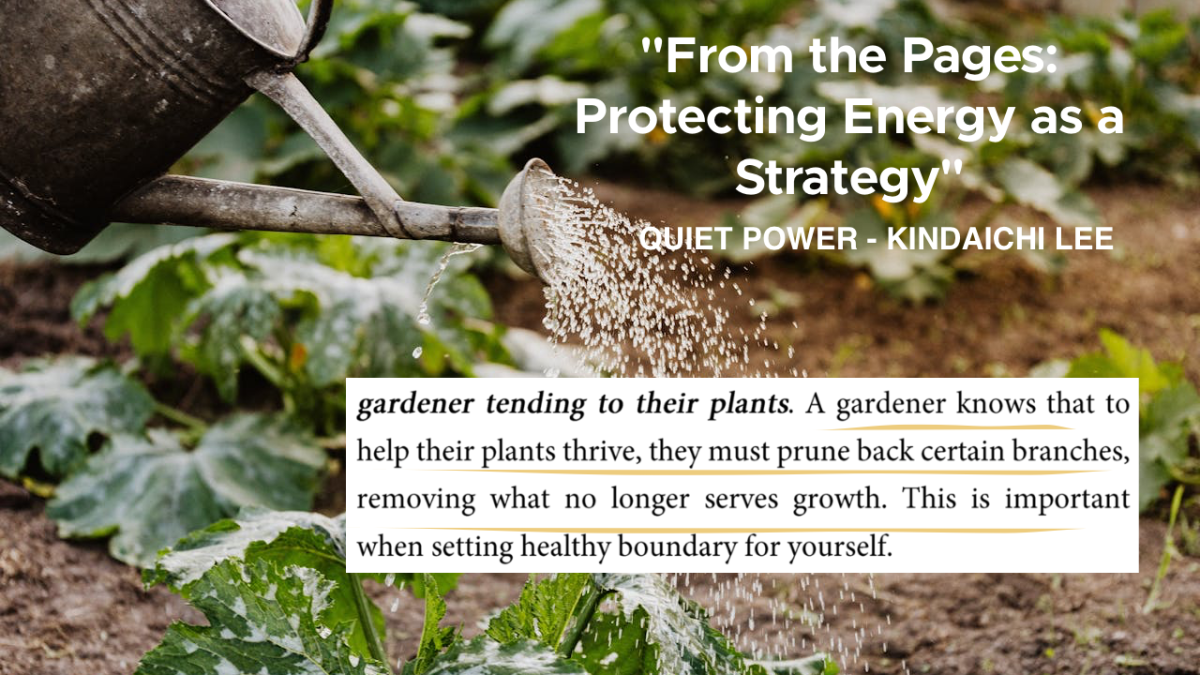
“A gardener knows that to help their plants thrive, they must prune back certain branches, removing what no longer serves growth. This is important when setting healthy boundary for yourself… prioritising your well-being is vital for sustainable leadership.”
Today, we are going to look at energy management not as a wellness initiative, but as a Revenue Strategy.
We are going to explore why your ability to say “No” (the prune) is directly correlated to the quality of your decision-making and your bottom line. I will share the story of a CEO who was drowning in commitments and how “pruning” his schedule didn’t just save his sanity—it saved his company’s quarter.
The Economics of Energy: The Battery vs. The Machine
The industrial model of work treats humans like machines. A machine runs at the same speed at 9:00 AM as it does at 5:00 PM. If you want more output, you just run the machine longer.
But humans—and specifically introverted leaders—are not machines. We are batteries.
Every interaction, every decision, and every conflict drains that battery.
- High Charge: You are empathetic, strategic, creative, and patient.
- Low Charge: You are reactive, irritable, short-sighted, and cynical.
This is where the “Revenue Strategy” comes in. If you make a $100,000 decision when your battery is at 10% (because you didn’t prune your schedule), you are statistically likely to make a bad decision. You might agree to a bad deal just to end the meeting. You might snap at a key employee, causing them to quit.
The cost of “hustling” through burnout is not just your health; it is the financial cost of your stupidity.
Protecting your energy is not an act of indulgence. It is your fiduciary duty to your team and your stakeholders. They need your brain to be online.
The Case Study: The “Zombie” CEO
Let me introduce you to “Daniel.”
Daniel was the founder of a mid-sized tech consultancy. He was a brilliant, introverted strategist (a Map Maker), but he was suffering from what I call “Founder’s Guilt.” He felt he had to say “Yes” to everything to prove his dedication.
- He attended every client kickoff.
- He interviewed every junior hire.
- He accepted every coffee request from aspiring entrepreneurs.
When he came to me, he wasn’t just tired; he was a zombie. “I’m working 14 hours a day,” he said, “but the revenue has flatlined. My team is frustrated because I’m the bottleneck for every decision. I feel like I’m hacking through a jungle with a butter knife.”
I looked at his calendar. It was a solid block of color from 8 AM to 7 PM.
“Daniel,” I said. “You aren’t leading. You are reacting. You have let the garden grow wild. We need to prune.”
He resisted. “I can’t cancel these meetings. These people expect me to be there. Pruning feels like I’m failing them.”
“No,” I countered. “Showing up to those meetings exhausted, distracted, and unable to add value is failing them. We are going to implement a Pruning Strategy to increase your Leadership Yield.”
The Intervention: The 30% Cut
We treated his energy like a budget. He was overspending. We needed to cut 30% of his commitments to restore his solvency.
We categorised his tasks into three buckets:
- The Trunk (Vital): Things only the CEO can do (Strategy, Key Investor Relations, Culture).
- The Branches (Important but Delegatable): Client kickoffs, hiring interviews.
- The Dead Wood (Rot): “Pick your brain” coffees, status update meetings that could be emails, fixing low-level operational fires.
The Prune:
- He cut the Dead Wood immediately. He declined all external coffee chats for 90 days.
- He trimmed the Branches. He empowered his VP of Sales to handle kickoffs. He told them, “I trust you. You don’t need me in the room to start the project.” (This actually boosted the VP’s confidence).
- He protected the Trunk. He blocked out 9 AM – 11 AM every day as “Deep Work” time. No meetings. Phone off.
The Result: The Million-Dollar Nap
The first two weeks were painful. Daniel felt guilty. He felt “lazy” leaving the office at 5:30 PM.
But in week four, something shifted. Because he wasn’t in back-to-back meetings, he had quiet time in the morning. During one of these Still-Point sessions, he noticed a trend in their client data that everyone else was too busy to see. He realized they were underpricing their core service by 20% relative to the market value they were delivering.
He had the energy to draft a new pricing strategy. He had the patience to negotiate it with their biggest client.
Because he was rested, he didn’t cave when the client pushed back. He held his ground with Quiet Authority. The client agreed to the new rate.
The Outcome:
- That single decision—which he only had the brainpower to make because he pruned his schedule—added $1.2 million to their annual revenue.
- His team was happier because he stopped micromanaging them (bottleneck removed).
- He started sleeping again.
If Daniel had continued “hustling” and refused to prune, he would have been too busy putting out fires to notice the gold mine under his feet.
His self-care didn’t cost the company money. It made the company money.
How to Become the Gardener (Your Strategy)
How do you apply this? How do you move from “Action Hero” to “Gardener”?
1. The “Energy Audit” (Identify the Dead Wood)
Look at your calendar for the last two weeks. Color-code the events:
- Green: Gave me energy / High ROI.
- Red: Drained me / Low ROI.
- Grey: Neutral. If you are an introvert and your calendar is 80% Red (constant social interaction without breaks), you are heading for a crash. You must identify one “Red” activity to prune this week.
2. The “Strategic No” (The Pruning Shears) Pruning is painful because we hate disappointing people. You need a script.
- The Script: “Thank you for the invitation. Right now, I am in a season of deep focus on [Key Project], so I am declining all non-essential meetings to ensure I deliver my best work there. I hope you understand.” Notice the framing. You aren’t saying “No” because you are tired. You are saying “No” because you are responsible. You are protecting the asset.
3. Implement “Fallow Seasons” In agriculture, fields are sometimes left “fallow” (unplanted) to restore the soil’s nutrients. If you plant continuously, the soil dies.
- Application: Schedule “Fallow Time.” A 15-minute buffer between meetings. A “No-Meeting Wednesday.” A lunch break where you actually leave your desk. This isn’t time off. It is time for restoration. It is how you ensure the next crop (the next decision) is healthy.
The “Selfish” Myth
The biggest barrier to this is the feeling that prioritizing yourself is selfish.
Let’s go back to the Gardener metaphor. If a Gardener prunes a tree, is he being “mean” to the branch he cuts off? Is he being selfish? No. He is serving the tree. He is ensuring the organism survives and bears fruit.
As a leader, you are the tree. Your team feeds off your energy, your clarity, and your stability. If you let yourself get overgrown, exhausted, and brittle, you provide no shade and no fruit.
By pruning your obligations—by setting that boundary—you are actually being the most generous version of yourself. You are ensuring that when you do show up, you show up whole.
“Prioritising your well-being is vital for sustainable leadership.”
Stop looking at your calendar as a measure of your worth. Look at it as a garden. Is it overgrown? Is it choking? Or is it pruned, spaced, and ready to grow?
Pick up the shears.
Until next week, prune for growth.
Kindaichi Lee, Your Transformative Storyteller 🎬