
Managing the “Loud” Aggressor: The Heavy Pause and the Boundary of Conviction
(EI & Relationship Mastery Newsletter – Season 5, Article 7)
Good morning from Kuala Lumpur.
Welcome back to Season 5: “The Conflict Architect.”
Over the past six weeks, we have been building a new paradigm for how introverted leaders handle friction. We have stopped playing the Gladiator, fighting to win, and started playing the Architect, observing to fix. We’ve learned to override our urge to flee, to anticipate fires before they ignite, to de-escalate boiling rooms, and to shut down the toxic whisper networks of office gossip.
We have built a strong, resilient foundation.
But today, that foundation is going to be tested by a wrecking ball.
We are going to tackle the most highly requested topic of this entire series. What does the quiet leader do when faced with a “Steamroller”?
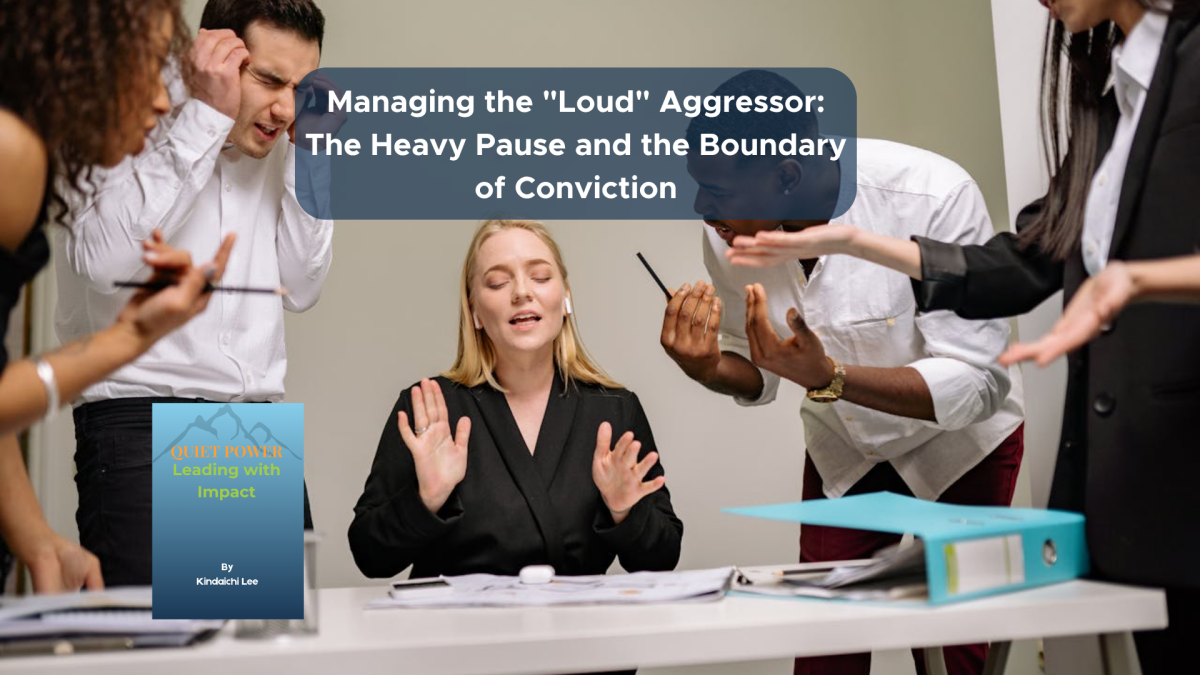
You know this person. It might be a domineering colleague, an overbearing boss, or an aggressive client. They interrupt. They talk over people. They use their physical presence and their volume to dominate the space. When you try to speak, they cut you off. They weaponize their extroversion to bulldoze the agenda.
For an introverted leader, a Steamroller is an absolute nightmare. Our natural instinct is to yield. We tell ourselves we are “taking the high road” by letting them talk, but in reality, our nervous systems are just trying to survive the cortisol spike.
When we yield to the Steamroller, we don’t just lose our voice; we lose our authority in the eyes of everyone else in the room.
In this seventh article, we are going to explore the psychology of the “Loud Aggressor.” More importantly, I am going to give you the Quiet Power tools to stop them in their tracks: The Heavy Pause and The Boundary of Conviction.
The Anatomy of the Steamroller
To stop a Steamroller, you must first understand what powers the engine.
When we see someone dominating a meeting, our first assumption is usually that they are malicious, arrogant, or narcissistic. Sometimes, that is true. But as Conflict Architects, we must look deeper at the structural dynamic.
In many cases, the Steamroller is driven by Anxiety.
They equate silence with a loss of control. If they are not talking, they feel vulnerable. They bulldoze not because they are strong, but because they are terrified of what might happen if they stop pushing. Their aggression is a defense mechanism.
When the Steamroller encounters an introverted leader, a toxic symbiotic cycle begins:
- The Aggressor Pushes: They raise their voice and interrupt.
- The Introvert Yields: We fall silent to avoid escalating the conflict and to protect our energy.
- The Aggressor is Rewarded: Because we yielded, their brain registers that “pushing works.”
- The Cycle Deepens: The next time, they push harder, and we yield faster.
The Steamroller expects one of two reactions from you:
- Submission: You back down and let them run the show. (They win).
- Escalation: You lose your temper and yell back. (They also win, because now you look out of control, and they are fighting on their home turf—volume).
To break the cycle, you must provide a third reaction. A reaction they cannot process. You must give them The Void.
The Quiet Power Tool: The Heavy Pause
In Season 4, we discussed “Strategic Silence” in the context of negotiation. Today, we are upgrading that tool into a defensive weapon. I call it The Heavy Pause.
When the Steamroller interrupts you or goes on a loud, aggressive rant, the worst thing you can do is try to talk over them. Your voice will sound strained, your breathing will get shallow, and you will look defensive.
Instead, let them hit a brick wall of silence.
Here is the exact choreography of The Heavy Pause:
1. The Physical Stop
The moment they interrupt you, immediately stop talking. Do not try to finish your sentence. Cut your words mid-syllable if you have to.
2. The Unwavering Gaze
Maintain direct, neutral eye contact. Do not look down at your notes (which signals submission). Do not glare (which signals escalation). Look at them with the calm, detached observation of a scientist watching an experiment.
3. The Silence
Let them finish their interruption. When they stop talking, do not reply immediately. This is the crucial step. Count to three in your head. One Mississippi. Two Mississippi. Three Mississippi.
In a tense room, three seconds of silence feels like an eternity.
The Psychology of the Heavy Pause:
Why does this work? Because a Steamroller thrives on momentum. They expect their words to crash into your words. When they crash into absolute silence, their momentum throws them off balance.
The silence becomes incredibly loud. It acts as an auditory mirror. In that three-second gap, the entire room—including the Steamroller—suddenly hears how aggressive, frantic, and out of line they sound.
You have not yelled. You have not insulted them. You have simply created a vacuum that sucks the power right out of their aggression.
The Boundary of Conviction
The Heavy Pause stops their momentum. But what you say immediately after the pause determines who controls the room.
You cannot follow a Heavy Pause with a weak, qualifying statement like, “Well, I just think maybe we should…”
You must follow the Heavy Pause with The Boundary of Conviction.
A boundary is not a threat. A boundary is not an argument. A boundary is a statement of architectural reality. It is an immovable line.
The Script for the Interruption:
After your three-second Heavy Pause, you speak. Your voice should be at your Still-Point—low, slow, and completely devoid of anger.
- You say: “I was speaking. I am going to finish my point now, and then I will gladly listen to yours.”
- Then, immediately pick up exactly where you left off. Do not ask for permission (“Is that okay?”). Just resume.
The Script for the Aggressive Rant:
If they have just gone on a loud tirade about how your team is failing, use the Heavy Pause, then deploy the Boundary of Conviction regarding their tone.
- You say: “I hear the urgency in your timeline, and we need to solve this. However, I will not engage in a conversation at this volume. When we can lower the temperature, we will fix the workflow.”
You are not fighting them. You are simply stating the conditions under which you are willing to operate.
The Case Study: The Client Who Owned the Room
Let me share the story of “David,” a Senior IT Consultant. David was a deep thinker, highly competent, but very quiet.
His firm was managing a massive software migration for a major logistics company. The client-side sponsor was a VP named “Richard.” Richard was the ultimate Steamroller. He was loud, he cursed, and he used his status as the “paying client” to bully David’s team.
During a critical project review, David was explaining a necessary delay in the server migration.
Richard exploded. He slammed his hand on the table. “I don’t want to hear another excuse from your team! I’m paying you millions of dollars, and you are dragging your feet! This is incompetent!”
He interrupted David three more times in the next two minutes. David’s team was watching, demoralized. David was experiencing the “Flight Response.” He wanted to apologise and get out of the room.
But David remembered the Architect Mindset. He remembered he was the thermostat, not the thermometer.
When Richard interrupted him for the fourth time, David executed The Heavy Pause.
He stopped talking immediately. He sat back in his chair. He put his pen down. He looked directly at Richard.
Richard ranted for another thirty seconds. Then, he stopped, expecting David to scramble for an apology.
David let the silence hang. One second. Two seconds. Three seconds. The silence in the boardroom was deafening. The other client executives started shifting uncomfortably in their seats. Richard’s face flushed.
Finally, David spoke. He used his Linguistic Scalpel. His voice was low and perfectly steady.
“Richard,” David said. “The technical realities of this server migration do not change based on the volume of this conversation. We are currently 48 hours behind schedule to ensure data integrity. If we rush it to appease your anger today, you will lose three years of client data tomorrow.”
David held the eye contact. He delivered the Boundary of Conviction.
“My team is here to build a secure system for you. We will not be spoken to as if we are incompetent. If we want to discuss the revised timeline constructively, we will do that now. If we want to continue shouting, I will take my team back to the office, and we will reconvene tomorrow.”
He didn’t yell. He didn’t blink. He just laid down the concrete boundary.
Richard blinked first. “Fine,” the VP muttered, suddenly very interested in his notebook. “Walk me through the timeline.”
David did not lose the client. In fact, Richard never interrupted David again for the remaining six months of the project. By refusing to yield, and refusing to escalate, David earned a respect that a Gladiator could never win.
How to Hold the Line This Week
If you have a Steamroller in your orbit, you cannot wait for the perfect moment to try this. You must prepare. Here is your application strategy:
1. The “Pre-Meeting” Mental Reps
If you know you are walking into a room with a Loud Aggressor, visualise the interruption before it happens. See them cutting you off. Visualise yourself stopping your sentence, feeling your feet on the floor (Anchor Breath), and holding the silence. If you practice the restraint in your mind, your amygdala won’t hijack you when it happens in reality.
2. The Broken Record Technique
Steamrollers will often test your boundary immediately to see if it is real. If you say, “I am going to finish my point,” they might interrupt again.
Do not change your script. Become a broken record.
- Them: (Interrupts again).
- You: (Heavy Pause). “As I just stated, I am going to finish my point.”
3. Depersonalise the Aggression
Remember the Architect’s mantra: Their volume is about their anxiety, not your competence. When they get loud, picture them as a panicked passenger on a ship. You are the captain. You do not yell at a panicked passenger; you project calm authority so they feel safe enough to calm down.
The Power of Not Yielding
We often confuse quietness with weakness. We assume that because we do not want to fight, we cannot defend ourselves.
This is the greatest lie the Extrovert Ideal has sold us.
You do not need a megaphone to hold a line. You do not need a broadsword to stop a bulldozer.
True authority is not about how much space you can take up with your voice. It is about how deeply you are rooted in your conviction. When you know the truth of your work, and you stand in the calm center of your Still-Point, the noise of the aggressor just washes over you like waves breaking on a rock.
The rock does not scream back at the ocean. It just stands there. And the ocean eventually recedes.
The next time the Steamroller comes for you, do not run. And do not fight.
Just pause. And let them hit the rock.
Until next week, hold your ground.
Kindaichi Lee, Your Transformative Storyteller 🎬